Causes of pregnant women abandoning dental care in primary care in Chile. A qualitative study
DOI:
https://doi.org/10.52611/confluencia.2026.1826Keywords:
Pregnancy, Dental care, Health services accessibility, Qualitative research, Patient dropoutsAbstract
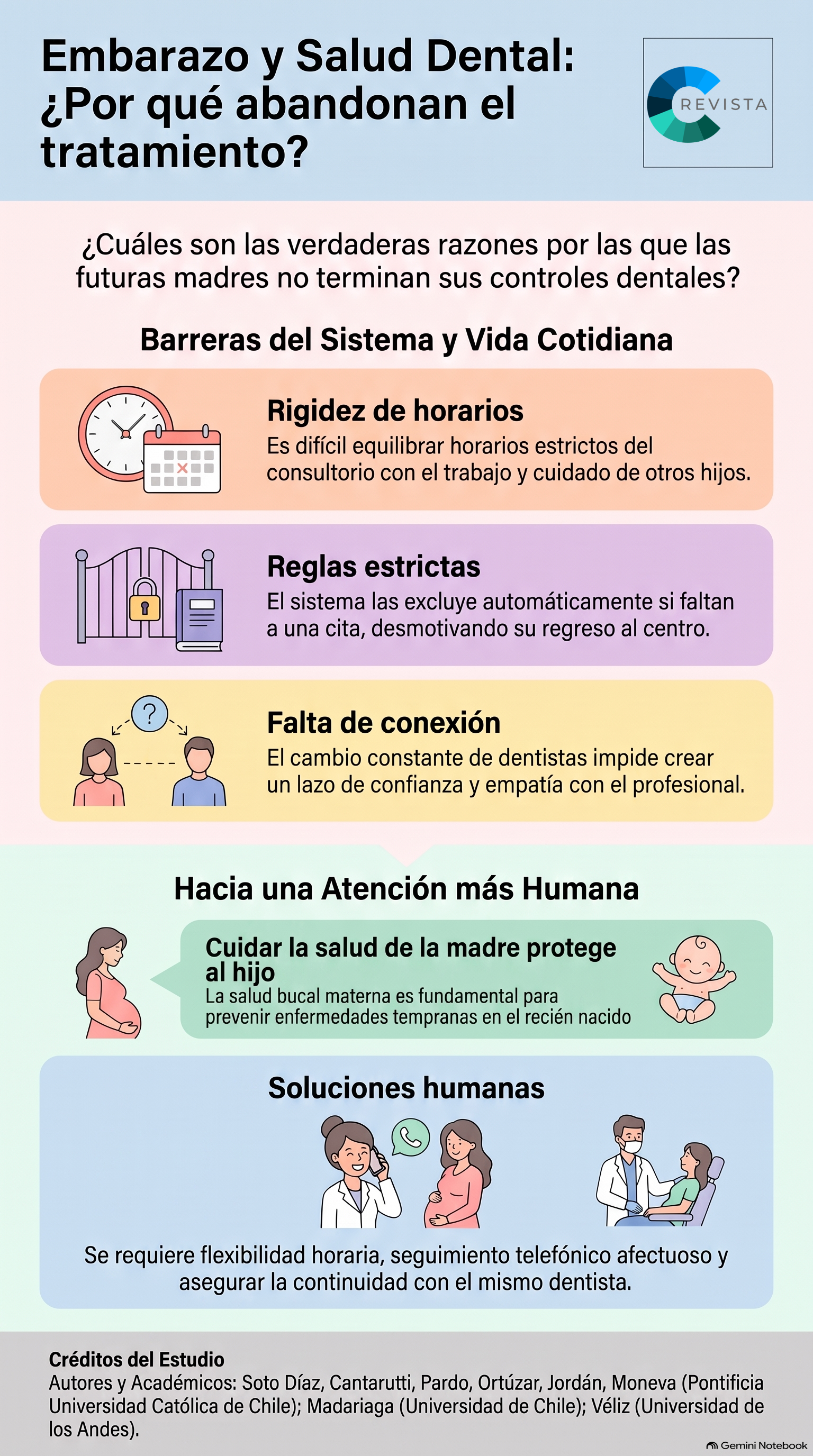
Introduction: In Chile dental care for pregnant women is guaranteed through the Explicit Health Guarantees system. However, many women who initiate treatment do not complete it. The reasons underlying treatment abandonment have been scarcely studied from the perspective of users. Objective: To understand the meaning attributed to dental treatment during pregnancy and the reasons leading to its abandonment, based on the experiences of women who accessed the guarantees. Methodology: A qualitative study was conducted using inductive content analysis of semi-structured interviews with women who did not complete dental treatment in Primary Healthcare. Convenience sampling was used; the analysis was performed manually and independently, and included validation of findings with participants. Result: Eleven interviews were conducted, from which seven themes emerged. Treatment abandonment was associated with difficulties in reconciling appointments with daily life demands, exacerbated by limited scheduling flexibility, appointment changes, and exclusion from the program after missed visits. A weak connection with the healthcare center was also identified, characterized by the absence of follow-up strategies, professional turnover, and limited information. Discussion: Treatment abandonment was not explained by traditional barriers such as cost, fear, or low oral health valuation, but rather by the difficulty of reconciling daily demands with an inflexible program and by a weak institutional relationship. Conclusion: Programs targeting pregnant women should provide appointment schedules compatible with daily life and strengthen patient–center follow-up and relationships to promote treatment continuity.
References
1. Organización Mundial de la Salud. Salud bucodental [Internet]. Ginebra: OMS; 2025 [citado el 17 de enero 2026]. Disponible en: https://www.who.int/es/news-room/fact-sheets/detail/oral-health
2. Haque F, Folayan MO, Virtanen JI. Maternal factors associated with early childhood caries among 3–5-year-old children with low socio-economic status in Trishal, Bangladesh. Front Oral Health [Internet]. 2023 [citado el 18 de enero 2026];4:1244359. Disponible en: https://doi.org/10.3389/froh.2023.1244359
3. Thearawiboon S, Rojanaworarit C. Risk of Early Childhood Caries Estimated by Maternal Dental Caries during Pregnancy: A Retrospective Cohort Study. Eur J Dent [Internet]. 2024 [citado el 18 de enero 2026];18(1):329-40. Disponible en: https://doi.org/10.1055/s-0043-1769896
4. Rocha JS, Arima L, Chibinski AC, Werneck RI, Moysés SJ, Baldani MH. Barriers and facilitators to dental care during pregnancy: a systematic review and meta-synthesis of qualitative studies. Cad Saude Publica [Internet]. 2018 [citado el 18 de enero 2026];34(8):e00130817. Disponible en: https://doi.org/10.1590/0102-311x00130817
5. Frey-Furtado L, Fonseca M, Melo P, Listl S, Pereira ML. Oral healthcare access: self-perceived barriers faced during pregnancy - a systematic review. BMC Public Health [Internet]. 2025 [citado el 18 de enero 2026];25(1):1394. Disponible en: https://doi.org/10.1186/s12889-025-22593-8
6. Al Jallad N, Manning S, Mao X, Mehta P, Wu TT, Cacciato R, et al. Identifying Patterns in Dental Visit Attendance Among Pregnant Women: A Retrospective Cohort Study. AJPM Focus [Internet]. 2025 [citado el 18 de enero 2026];4(2):100322. Disponible en: https://doi.org/10.1016/j.focus.2025.100322
7. Kamalabadi YM, Campbell MK, Zitoun NM, Jessani A. Unfavourable beliefs about oral health and safety of dental care during pregnancy: a systematic review. BMC Oral Health [Internet]. 2023 [citado el 18 de enero 2026];23(1):762. Disponible en: https://doi.org/10.1186/s12903-023-03439-4
8. Onwuka C, Onwuka CI, Iloghalu EI, Udealor PC, Ezugwu EC, Menuba IE, et al. Pregnant women utilization of dental services: still a challenge in low resource setting. BMC Oral Health [Internet]. 2021 [citado el 18 de enero 2026];21(1):384. Disponible en: https://doi.org/10.1186/s12903-021-01746-2
9. Cantarutti Martínez CR, Veliz Paiva CP, Pardo A, Ortuzar I, Jordán V, Moneva M, et al. ¿Cuáles son las barreras de acceso a la atención odontológica de las mujeres embarazadas? Una revisión de la literatura. ARS Med [Internet]. 2017 [citado el 18 de enero 2026];42(2):50-4. Disponible en: https://doi.org/10.11565/arsmed.v42i2.890
10. Ministerio de Salud de Chile. Guía Clínica AUGE. Salud Oral Integral de la Embarazada. Serie Guías Clínicas MINSAL 2013 [Internet]. Santiago: MINSAL; 2013 [citado el 18 de enero 2026]. Disponible en: https://diprece.minsal.cl/wrdprss_minsal/wp-content/uploads/2014/12/Atenci%C3%B3n-Odontol%C3%B3gica-Integral-Embarazada.pdf
11. Soto Villela I, Dehnhardt Canela B, Silva Oliva A, San-Martín-Roldán D, Calzadilla-Núñez A, Díaz-Narváez VP. Garantías explícitas en salud odontológica de las embarazadas y la salud pública por regiones y años 2010-2019 en Chile. Salud Uninorte [Internet]. 2022 [citado el 18 de enero 2026];38(2):505-28. Disponible en: https://doi.org/10.14482/sun.38.2.617.6
12. Guerrero-Nancuante C, Melo A, Gundelach P, Fuster N. Participación social en el sistema de salud de Chile: aportes reflexivos desde la bioética. Salud Colect [Internet]. 2023 [citado el 18 de enero 2026];19:e4486. Disponible en: https://doi.org/10.18294/sc.2023.4486
13. Marshall C, Rossmann GB. Designing qualitative research. 5th ed. Thousand Oaks (CA): Sage Publications; 2010. 320 p.
14. Patton MQ. Qualitative research and evaluation methods. 3rd ed. Thousand Oaks (CA): Sage Publications; 2002. 598 p.
15. Beca-Infante JP. La relación médico-paciente en el siglo 21. Rev Chil Enferm Respir [Internet]. 2018 [citado el 18 de enero 2026];34(4):209-11. Disponible en: https://doi.org/10.4067/s0717-73482018000400209
16. Sfeatcu R, Balgiu BA, Mihai C, Petre A, Pantea M, Tribus L. Gender Differences in Oral Health: Self-Reported Attitudes, Values, Behaviours and Literacy among Romanian Adults. J Pers Med [Internet]. 2022 [citado el 18 de enero 2026];12(10):1603. Disponible en: https://doi.org/10.3390/jpm12101603
17. Mendes L, Emmanuelli B, Segatto MDC, Knorst JK, Tomazoni F, Araújo G. Determinants of the use of dental services in the pre-gestational and gestational periods: a cross-sectional study. Cad Saude Publica [Internet]. 2025 [citado el 18 de enero 2026];41(7):e00179524. Disponible en: https://doi.org/10.1590/0102-311xpt179524
18. Liu PP, Wen W, Yu KF, Gao X, Wong MCM. Dental Care-Seeking and Information Acquisition During Pregnancy: A Qualitative Study. Int J Environ Res Public Health [Internet]. 2019 [citado el 18 de enero 2026];16(14):2621. Disponible en: https://doi.org/10.3390/ijerph16142621
19. Castro NCF, Barroso VMGP, Melo HC, Lima CASO, Pinto RS, Zina LG. Changes, Desire, Fear and Beliefs: Women's Feelings and Perceptions About Dental Care During Pregnancy. Int J Environ Res Public Health [Internet]. 2025 [citado el 18 de enero 2026];22(8):1211. Disponible en: https://doi.org/10.3390/ijerph22081211
20. Bahramian H, Mohebbi SZ, Khami MR, Quinonez RB. Qualitative exploration of barriers and facilitators of dental service utilization of pregnant women: a triangulation approach. BMC Pregnancy Childbirth [Internet]. 2018 [citado el 18 de enero 2026];18(1):153. Disponible en: https://doi.org/10.1186/s12884-018-1773-6
21. Winckler K, Rasmussen MU, Laugenborg J, Bukkehave KH, Fischer H, Heitmann BL, et al. Barriers for why pregnant women do not visit a dentist on a regular basis: using group concept mapping methodology. Acta Odontol Scand [Internet]. 2024 [citado el 18 de enero 2026];83:30-7. Disponible en: https://doi.org/10.1080/00016357.2023.2283198
22. Kamalabadi YM, Campbell MK, Gratton R, Athanasakos A, Haddad M, Jessani A. Oral health-related beliefs among a sample of pregnant women in Southwestern Ontario: a descriptive study. Front Oral Health [Internet]. 2024 [citado el 18 de enero 2026];5:1485815. Disponible en: https://doi.org/10.3389/froh.2024.1485815
23. Organización Mundial de la Salud. Gender and health [Internet]. Ginebra: OMS; 2026 [citado el 18 de enero 2026]. Disponible en: https://www.who.int/health-topics/gender?utm_source=chatgpt.com#tab=tab_1
24. Ahmed S, Shah H, Hussain A, Riafat S, Shaheen MN, Qureshi NA. Challenges in oral health referral during pregnancy: perspectives from antenatal and dental care providers. BMC Oral Health [Internet]. 2025 [citado el 18 de enero 2026];25(1):858. Disponible en: https://doi.org/10.1186/s12903-025-06285-8
25. Engström SG, André M, Arvidsson E, Östgren CJ, Troein M, Borgquist L. Personal GP continuity improves healthcare outcomes in primary care populations: a systematic review. Br J Gen Pract [Internet]. 2025 [citado el 18 de enero 2026];75(757):e518-e525. Disponible en: https://doi.org/10.3399/bjgp.2024.0568
26. Correa Zambrano ML. La humanización de la atención en los servicios de salud: un asunto de cuidado. Rev Cuidarte [Internet]. 2016 [citado el 18 de enero 2026];7(1):1210-8. Disponible en: https://doi.org/10.15649/cuidarte.v7i1.300
27. Babygeetha A, Devineni D. Social Support and Adherence to Self-Care Behavior Among Patients With Coronary Heart Disease and Heart Failure: A Systematic Review. Eur J Psychol [Internet]. 2024 [citado el 18 de enero 2026];20(1):63-77. Disponible en: https://doi.org/10.5964/ejop.12131
28. Howard AH, Gwenzi GD, Newsom L, Gebru BT, Gilbertson Wilke N. Howard AH, et al. The Relationship between Sense of Belonging and Well-Being Outcomes in Emerging Adults with Care Experience. Int J Environ Res Public Health [Internet]. 2023 [citado el 18 de enero 2026];20(13):6311. Disponible en: https://doi.org/10.3390/ijerph20136311
29. Salinas-Rehbein B, Ortiz MS, Robles TF. Perceived social support and treatment adherence in Chileans with type 2 diabetes. J Health Psychol [Internet]. 2025 [citado el 18 de enero 2026];30(5):887-97. Disponible en: https://doi.org/10.1177/13591053241253370
30. Shahin W, Kennedy GA, Stupans I. The association between social support and medication adherence in patients with hypertension: A systematic review. Pharm Pract (Granada) [Internet]. 2021 [citado el 18 de enero 2026];19(2):2300. Disponible en: https://doi.org/10.18549/pharmpract.2021.2.2300
31. Ministerio de Salud de Chile. Programas de participación y promoción de la salud [Internet]. Santiago: MINSAL; 2015 [citado el 18 de enero 2026]. Disponible en: https://www.minsal.cl/promocion_participacion_objetivos/
32. Filler T, Jameel B, Gagliardi AR. Barriers and facilitators of patient centered care for immigrant and refugee women: a scoping review. BMC Public Health [Internet]. 2020 [citado el 18 de enero 2026];20(1):1013. Disponible en: https://doi.org/10.1186/s12889-020-09159-6
33. Jones B, Heslop D, Harrison R. Seldom heard voices: a meta-narrative systematic review of Aboriginal and Torres Strait Islander peoples healthcare experiences. Int J Equity Health [Internet]. 2020 [citado el 18 de enero 2026];19(1):222. Disponible en: https://doi.org/10.1186/s12939-020-01334-w
Downloads
Published
Issue
Section
License
Copyright (c) 2026 Revista Confluencia

This work is licensed under a Creative Commons Attribution-NonCommercial-NoDerivatives 4.0 International License.