
Undergraduate education and cultural transfer Study on graphic brands in the Canary Islands.
Article Sidebar
Article Details
Issue

This work is licensed under a Creative Commons Attribution-NonCommercial-NoDerivatives 4.0 International License.
Downloads
Main Article Content
Abstract
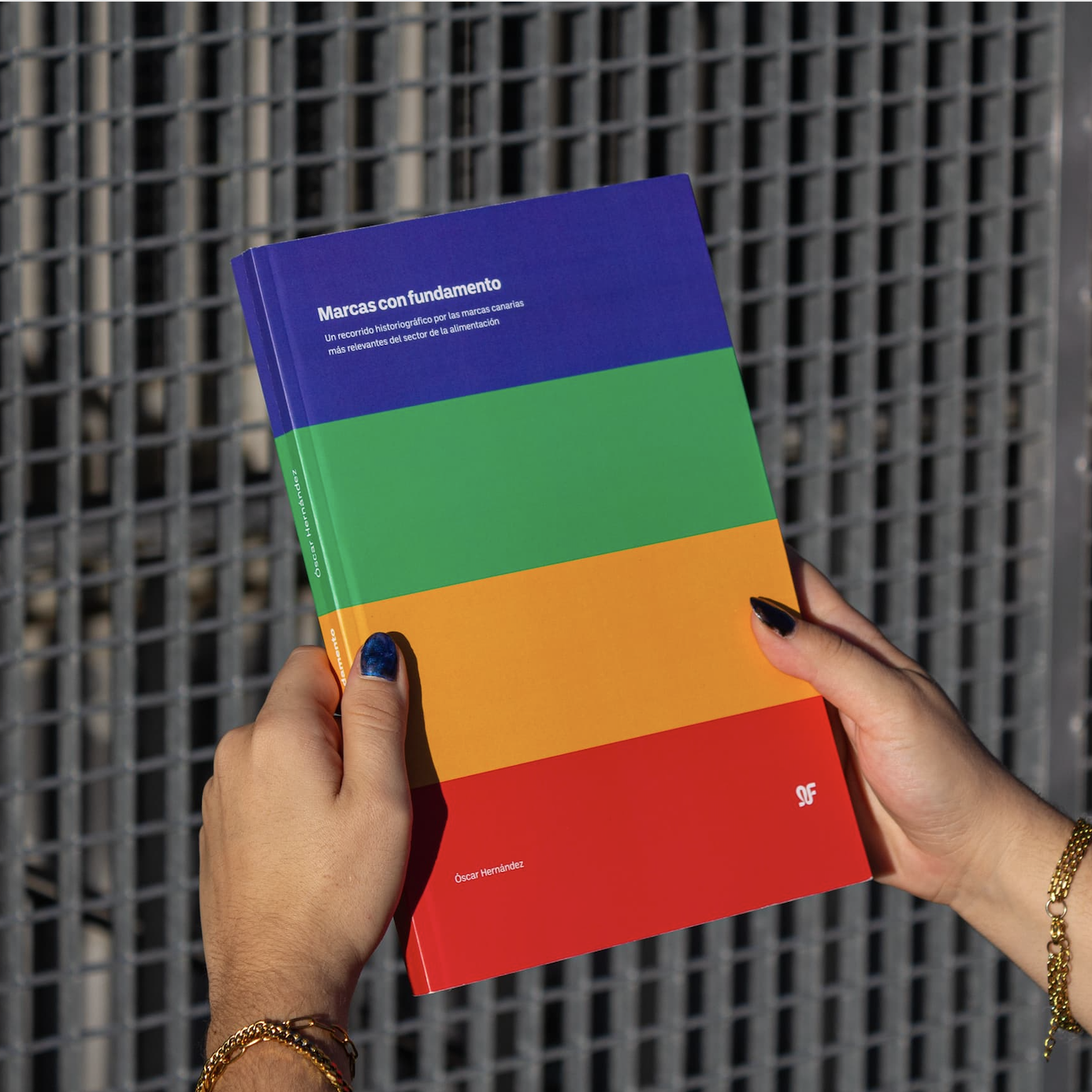
This article analyzes the role of undergraduate education in legitimizing design research and its social impact, based on a Final Degree Project in graphic design (FDP). The case studied is the project Marcas con fundamento (Brands with substance), defended at the University of La Laguna in 2023, which focuses on the historiographical study of Canarian graphic brands. Methodologically, the project adopted a mixed approach—historiographical, qualitative, and project-based—articulated as research through design and organized into five phases, with a sample of 30 graphic brands. The results enabled the identification of patterns of visual evolution, the creation of a graphic archive, and the development of various cultural transfer products, including a publication, a website, an educational game, and a public exhibition. The conclusions show that the FDP can operate as an applied research laboratory, integrating theory and practice, strengthening territorial identity, and democratizing visual culture. Based on this case, a replicable model of university-society transfer applicable to educational and cultural contexts is proposed.
How to Cite
References
Bonsiepe, G. (2005, 24 de junio). Diseño y democracia. [Conferencia en la UTEM, Universidad Tecnológica Metropolitana] Santiago de Chile, Chile, http://www.guibonsiepe.com/wp-content/uploads/2019/04/Conferencia_Chile_2005_pdf.zip
Cross, N. (1982). Designerly Ways of Knowing. Design Studies, 3(4), 221-227. https://doi.org/10.1016/0142-694X(82)90040-0
Frascara, J., Gardien, P., Noël, G., Rosenberg, D., Stappers, P. J., & Wilde, D.(2023) Towards strengthening Methods in Design Education and Practice. In D. Jones, N. Borekci, V. Clemente, J. Corazzo, N. Lotz, L. M. Nielsen, L-A. Noel (eds.), The 7th International Conference for Design Education Researchers, 29 November - 1 December 2023, London, United Kingdom. https://doi.org/10.21606/drslxd.2024.029
Frayling, C. (1993). Research in art and design. Royal College of Art Research Papers, 1(1). https://researchonline.rca.ac.uk/384/9/frayling_research_in_art_and_design_1993_OCR.pdf
Ghajargar, M., & Bardzell, J. (2019). What design education tells us about design theory: a pedagogical genealogy. Digital Creativity, 30(4), 277–299. https://doi.org/10.1080/14626268.2019.1677723
Harland, R. G. (2024). Developing an explanatory hypothesis for urban graphic heritage through the observation of physical traces. The design journal, 27(3), 511-532. https://doi.org/10.1080/14606925.2024.2339651
Harland, R. G., Bridge, J., Nash, M., & Rabagliati, M. (2024). Utilising Graphic Heritage for Heritage Interpretation: A Case Report on Testing the Applicability of Graphic Heritage as a Development Tool for UNESCO Heritage Designations. Heritage & Society, 17(1), 117-143. https://doi.org/10.1080/2159032X.2023.2248580
Hernández García, O. (2023). Marcas con fundamento: un recorrido historiográfico por las marcas canarias más relevantes del sector de la alimentación (Trabajo Fin de Grado, Universidad de La Laguna). http://riull.ull.es/xmlui/handle/915/33969
Julier, G. (2010). La Cultura del Diseño. Editorial GG.
Lee, D. Y., & Bain, J. (2016). Developing a Cross-Cultural Design Methodology: A study of UK-South Korean Collaboration in Higher-Education Design. The Global e-Learning Journal, 5(2). https://research.gold.ac.uk/id/eprint/20273/
Lee, D. Y., & Waller, M. (2016). Cross-cultural design learning tool: Cross-cultural design (CCD) approach: A study of South Korean student projects in collaboration with Goldsmiths, University of London, UK. In P.-L. P. Rau (Ed.), Cross-cultural design: 8th International Conference, CCD 2016, held as part of HCI International 2016, Toronto, Canada, July 17–22, 2016 (pp. 89–97). Springer. https://doi.org/10.1007/978-3-319-40093-8_10
Lees-Maffei, G. & Houze R. (2021). Design and Heritage: The Construction of Identity and Belonging. Routledge. https://doi.org/10.4324/9781003096146
Margolin, V. (2005). Las políticas de lo artificial. Ensayos y estudios sobre diseño. Editorial Designio.
McKenney, S., & Reeves, T. C. (2020). Conducting Educational Design Research. Routledge.
Ramírez-Montoya, M., & García-Peñalvo, F. (2018). Co-creation and open innovation: Systematic literature review. Comunicar, 54, 09–18. https://doi.org/10.3916/C54-2018-01
Sandoval Gallegos, M. G., Oviedo Cevallos, F. V., & Villacrés Pumagualle, M. L. (2025). Influencia de las manifestaciones culturales en los trabajos de titulación de Diseño Gráfico en la Escuela Superior Politécnica de Chimborazo. LATAM Revista Latinoamericana de Ciencias Sociales y Humanidades, 6(3), 1850-1862. https://doi.org/10.56712/latam.v6i3.4081
Setlhatlhanyo, K. N., Marope, O., Moalosi, R., & Sealetsa, O. J. (2019). Developing creative product designs inspired by ethnic cultural heritage: A case study of design students at the University of Botswana. Form Akademisk - Research Journal of Design and Design Education, 12(5) https://doi.org/10.7577/FORMAKADEMISK.2489
Songel González, G. (2011). La investigación en diseño. Boletín IMPIVA Disseny. (26):8-10. https://riunet.upv.es/handle/10251/72795https://riunet.upv.es/handle/10251/72795
Ynoub, R. (2020). Epistemología y metodología en y de la investigación en Diseño. Cuadernos del Centro de Estudios de Diseño y Comunicación, 82. https://doi.org/10.18682/cdc.vi82.3711