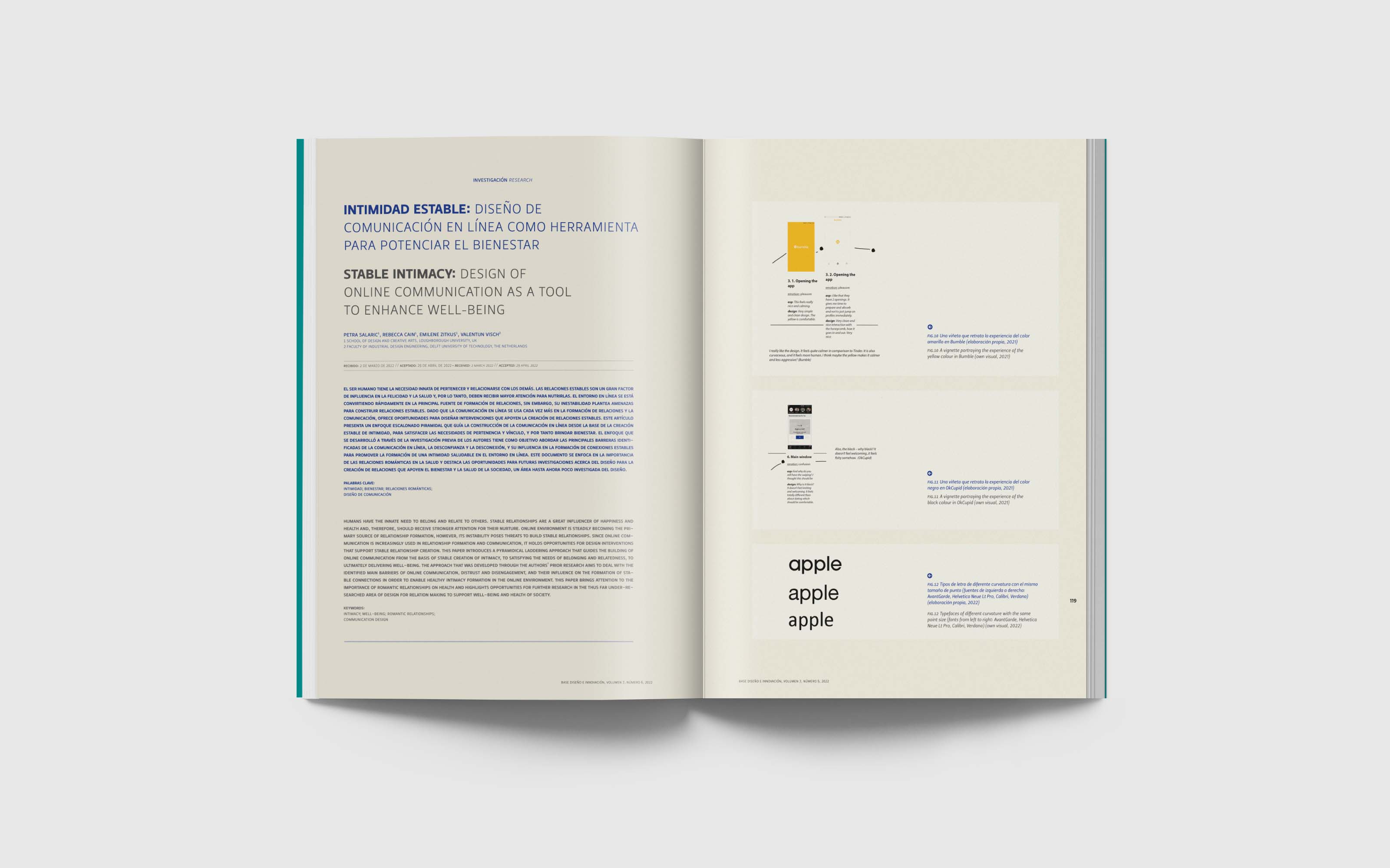
Stable intimacy Design of online communication as a tool to enhance wellbeing

Main Article Content

Petra Salaric
Rebecca Cain
Emilene Zitkus
Valentijn Visch

Abstract

Humans have the innate need to belong and relate to others. Stable relationships are a great influencer of happiness and health and, therefore, should receive stronger attention for their nurture. Online environment is steadily becoming the primary source of relationship formation, however, its instability poses threats to build stable relationships. Since online communication is increasingly used in relationship formation and communication, it holds opportunities for design interventions that support stable relationship creation. This paper introduces a pyramidical laddering approach that guides the building of online communication from the basis of stable creation of intimacy, to satisfying the needs of belonging and relatedness, to ultimately delivering wellbeing. The approach that was developed through the authors’ prior research aims to deal with the identified main barriers of online communication, distrust and disengagement, and their influence on the formation of stable connections in order to enable healthy intimacy formation in the online environment. This paper brings attention to the importance of romantic relationships on health and highlights opportunities for further research in the thus far under-researched area of design for relation making to support wellbeing and health of society.

Keywords:
intimacy, wellbeing, romantic relationships, communication design

How to Cite

Salaric, P., Cain, R. ., Zitkus, E., & Visch, V. (2022). Stable intimacy: Design of online communication as a tool to enhance wellbeing . Base Diseño E Innovación, 7(6), 110-125. https://doi.org/10.52611/bdi.num6.2022.784

References

Author Biographies

Petra Salaric, School of Design and Creative Arts, Loughborough University

Petra Salaric is a doctoral researcher at the School of Design and Creative Arts at Loughborough University. Within the area of design for wellbeing, she focuses on behaviour change and emotions, and specialises in taboo topics.

Rebecca Cain, School of Design and Creative Arts, Loughborough University

Rebecca Cain, PhD, is a Professor of Transdisciplinary Design and an Associate Dean in the school of Design and Creative Arts at Loughborough University. She is the Vice-Chair of the DRS Executive Board and was the founding convenor of the DRS Special Interest Group for Happiness, Health and Wellbeing (SIGWELL).

Emilene Zitkus, School of Design and Creative Arts, Loughborough University

Emilene Zitkus, PhD, is a Lecturer in Inclusive Design, UX, and User Centred Design at Loughborough University. She is a member of the editorial board of the Design for Health journal and visiting Lecturer at UNESP. Her expertise in inclusive design has developed during the last 13 years through projects developed within partners in industry, including Ford and Jaguar-Land Rover and EPSRC projects, including her PhD at the University of Cambridge.

Valentijn Visch, Faculty of Industrial Design Engineering, Delft University of Technology

Valentijn Visch, PhD, is an Associate Professor at the Faculty of Industrial Design Engineering (IDE at TU Delft. His research is focused on Design for Health Motivation. He coordinates Persuasive Game Design research, chairs the IDE eHealth research lab, and is project leader of several health-related interdisciplinary research projects including subjects like storytelling, digital twins, eHealth & game design, health literacy, obesity prevention, reaching people with low SEP and health journeys.