
Shaping Human-Driven Validation in AI-Integrated Design Education
Barra lateral del artículo
Detalles del artículo

Esta obra está bajo una licencia internacional Creative Commons Atribución-NoComercial-SinDerivadas 4.0.
##plugins.themes.bootstrap3.displayStats.downloads##
Contenido principal del artículo
Resumen
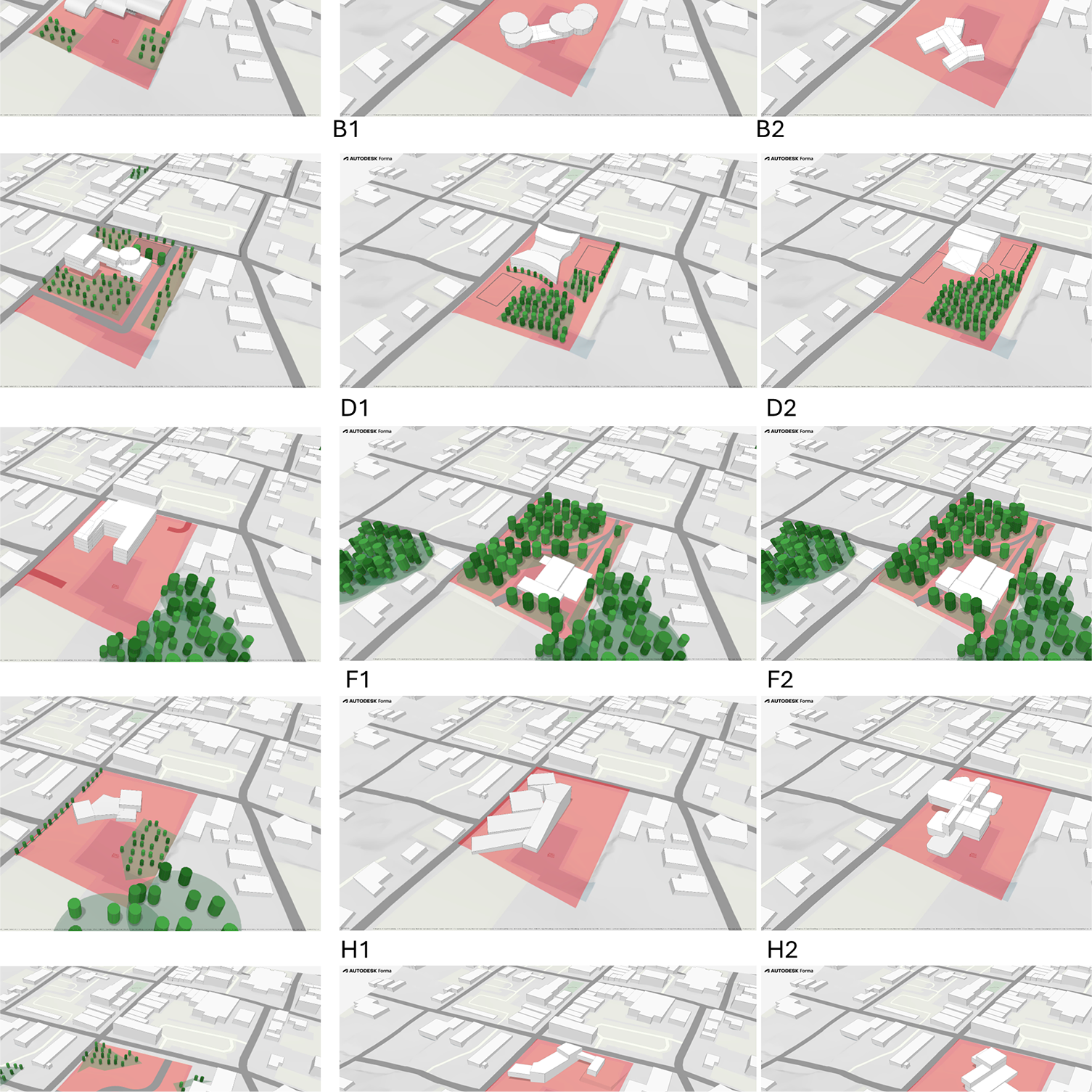
Generative artificial intelligence (AI) is increasingly used in design education to support early-stage tasks such as programming, ideation, and environmental analyses. Yet its educational value depends on how students learn to question, verify, revise, and justify AI-supported outputs rather than uncritical adoption. The present study compares two pedagogical cases: a text-to-program workflow in a Council for Interior Design Accreditation (CIDA)-accredited interior architecture course and a performance-based mass study workflow in a National Architectural Accrediting Board (NAAB)-accredited architecture course. Using Linguistic Informatics and Geometric Synthesis (LIGS) as a cross-modal analytical framework, this study analyzes 1,081 structured reflection responses from 61 students, 9 AI-generated draft programs, 9 revised adjacency matrices, and environmental performance outputs from 20 design options. The findings show that AI became pedagogically meaningful when students treated generated material as provisional input for judgment. In Case A, students used a Keep, Revise, Reject pattern to evaluate AI-generated programmatic suggestions against user needs, adjacency logic, code-related concerns, and spatial feasibility. In Case B, students used environmental feedback from the simulations to compare massing alternatives and interpret the trade-offs among different criteria in design and environmental performance. These findings were understood as illustrative rather than representative. Across both cases, AI-supported learning depended on human-driven validation, trust calibration, metacognitive awareness, and decision ownership. The present study offers exploratory comparative evidence for a human-centered and a performance-based approach to AI-integrated design education.
Cómo citar
Referencias
Arora, P. (2025). Creative data justice: A decolonial and indigenous framework to assess creativity and artificial intelligence. Information, Communication & Society, 28(13), 2231–2247. https://doi.org/10.1080/1369118X.2024.2420041
Buolamwini, J. (2024). Unmasking AI: My mission to protect what is human in a world of machines. Random House.
Chiou, L.-Y., Hung, P.-K., Liang, R.-H., & Wang, C.-T. (2023). Designing with AI: An Exploration of Co-Ideation with Image Generators. In Proceedings of the 2023 ACM Designing Interactive Systems Conference (pp. 1941–1954). Association for Computing Machinery. https://doi.org/10.1145/3563657.3596001
Council for Interior Design Accreditation. (2024). CIDA Professional Standards 2024. https://cida.org/professional-standards
Cross, N. (2001). Designerly ways of knowing: Design discipline versus design science. Design Issues, 17(3), 49–55. https://doi.org/10.1162/074793601750357196
Darvishi, A., Khosravi, H., Sadiq, S., Gašević, D., & Siemens, G. (2024). Impact of AI assistance on student agency. Computers & Education, 210, 104967. https://doi.org/10.1016/j.compedu.2023.104967
Ehsan, U., Liao, Q. V., Passi, S., Riedl, M. O., & Daumé, H. (2024). Seamful XAI: Operationalizing seamful design in explainable AI. Proceedings of the ACM on Human-Computer Interaction, 8(CSCW1), 1–29. https://doi.org/10.1145/3637396
Kalay, Y. E. (2004). Architecture’s new media: Principles, theories, and methods of computer-aided design. MIT Press.
Knoth, N., Tolzin, A., Janson, A., & Leimeister, J. M. (2024). AI literacy and its implications for prompt engineering strategies. Computers and Education: Artificial Intelligence, 6, 100225. https://doi.org/10.1016/j.caeai.2024.100225
Liao, Q. V., Gruen, D., & Miller, S. (2020). Questioning the AI: Informing design practices for explainable AI user experiences. In Proceedings of the 2020 CHI Conference on Human Factors in Computing Systems (pp. 1–15). Association for Computing Machinery. https://doi.org/10.1145/3313831.3376590
Melker, S., Gabrils, E., Villavicencio, V., Faraon, M., & Rönkkö, K. (2025). Artificial intelligence for design education: A conceptual approach to enhance students’ divergent and convergent thinking in ideation processes. International Journal of Technology and Design Education, 35(5), 1871–1899. https://doi.org/10.1007/s10798-025-09964-3
National Architectural Accrediting Board (NAAB). (2025). 2020 Conditions for Accreditation (May 2025 Revised Edition). https://higherlogicdownload.s3.amazonaws.com/NAAB/21e8eae7-e532-47c0-bff1-4111ca0d4fb0/UploadedImages/PDFs/2020_NAAB_Conditions_for_Accreditation_Rev_20250501.pdf
Ofosu-Asare, Y. (2025). Cognitive imperialism in artificial intelligence: Counteracting bias with Indigenous epistemologies. AI & SOCIETY, 40(4), 3045–3061. https://doi.org/10.1007/s00146-024-02065-0
Oxman, R. (2008). Performance-based design: Current practices and research issues. International Journal of Architectural Computing, 6(1), 1–17. https://doi.org/10.1260/147807708784640090
Park, J. (2026). Artificial intelligence in design education: A systematic review and CIDA-Aligned framework for interior architecture and design. Enquiry The ARCC Journal for Architectural Research, 23(1), 60–80. https://doi.org/10.17831/enqarcc.v23i1.1329
Stoimenova, N., & Price, R. (2020). Exploring the nuances of designing (with/for) artificial intelligence. Design Issues, 36(4), 45–55. https://doi.org/10.1162/desi_a_00613
Tellez, F. A. (2025). Reflecting on the integration of generative AI in design education: Lessons from the field. Voces y Silencios. Revista Latinoamericana de Educación, 16(2), 169–191. https://doi.org/10.18175/VyS16.2.2025.9
Verganti, R., Vendraminelli, L., & Iansiti, M. (2020). Innovation and design in the age of artificial intelligence. Journal of Product Innovation Management, 37(3), 212–227. https://doi.org/10.1111/jpim.12523
Xu, X., Qiao, L., Cheng, N., Liu, H., & Zhao, W. (2025). Enhancing self‐regulated learning and learning experience in generative AI environments: The critical role of metacognitive support. British Journal of Educational Technology, 56(5), 1842–1863. https://doi.org/10.1111/bjet.13599
Zhang, L. (2023). The ethical turn of emerging design practices. She Ji: The Journal of Design, Economics, and Innovation, 9(3), 311–329. https://doi.org/10.1016/j.sheji.2023.09.002