
Diseñar desde algún lugar IA generativa y futuros clausurados en el diseño
Barra lateral del artículo
Detalles del artículo

Esta obra está bajo una licencia internacional Creative Commons Atribución-NoComercial-SinDerivadas 4.0.
##plugins.themes.bootstrap3.displayStats.downloads##
Contenido principal del artículo
Resumen
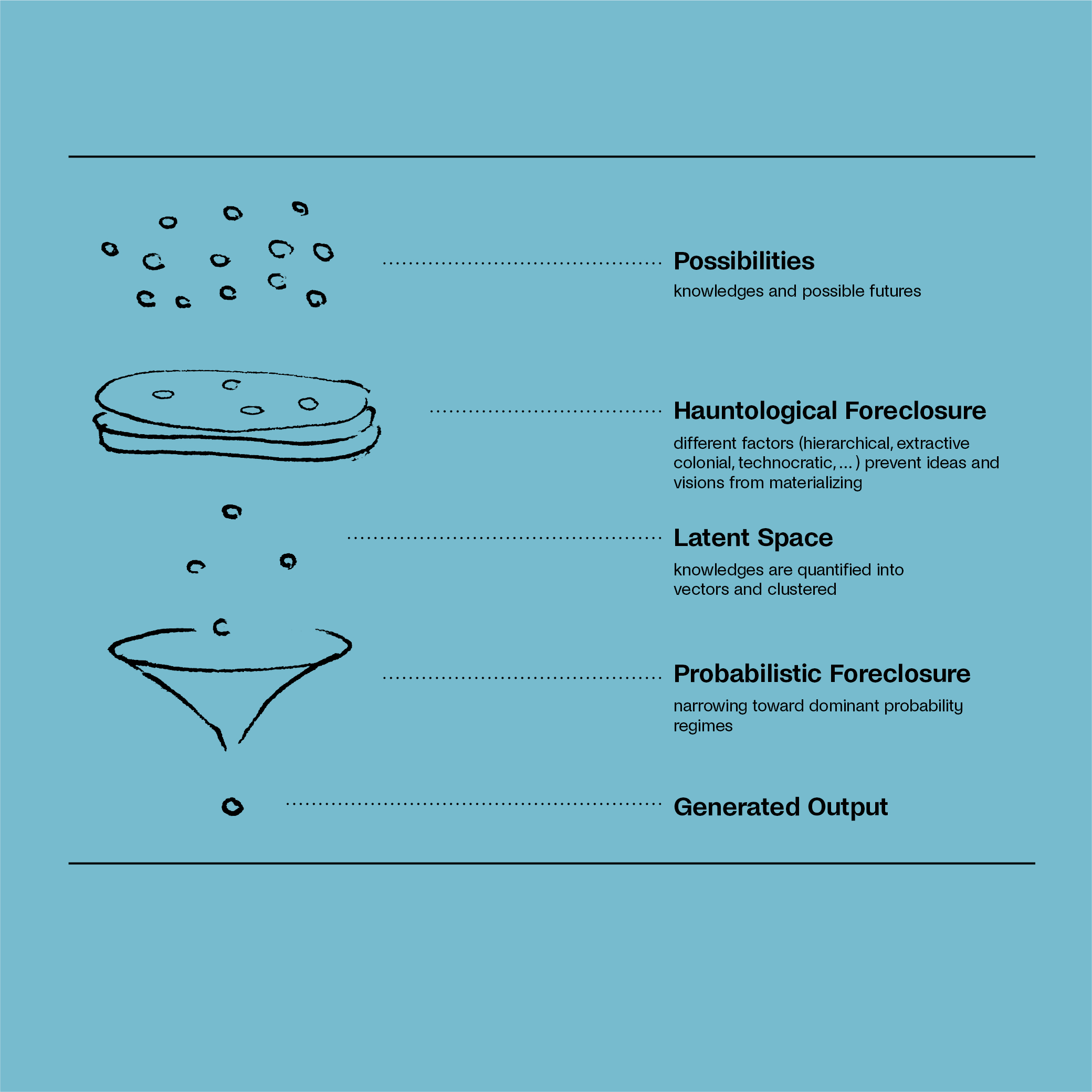
La integración de la inteligencia artificial generativa en el diseño es ampliamente celebrada por acelerar los flujos de trabajo y ampliar la generación de ideas. Este artículo sostiene, sin embargo, que esta perspectiva instrumental oculta un cambio epistémico fundamental: la IA generativa no solo acelera los procesos de diseño, sino que afianza estructuralmente prácticas ya excluyentes. Al externalizar los procesos exploratorios, ambiguos y materiales de búsqueda de formas en operaciones probabilísticas, la IA socava el diseño en tanto que cultura de conocimiento situada. Basándonos en teorías sobre infraestructura epistémica, hauntología y crítica decolonial, analizamos cómo los sistemas de IA funcionan como motores de convergencia que proyectan una visión dominante desde un lugar concreto y la presentan como un estándar neutral para todos los lugares y todas las personas. A través de una doble clausura —hauntológica y probabilística—, estos sistemas favorecen formas de conocimiento ya presentes en el archivo digital dominante, al tiempo que vuelven estructuralmente inaccesibles los futuros alternativos del diseño. Para contrarrestar esta homogeneización, el artículo propone un giro conceptual. Al reimaginar los modelos de IA no como infraestructuras universalizadoras, sino como contenedores localizados de epistemologías situadas, examinamos críticamente cómo tales alternativas pueden reproducir las asimetrías que pretenden abordar. Al situar el cuidado como condición necesaria para mantener abiertos los procesos epistémicos, los diseñadores y educadores pueden resguardar las condiciones procesuales en las que emergen los saberes diversos.
Cómo citar
Referencias
Arora, P. (2025). Creative data justice: A decolonial and indigenous framework to assess creativity and artificial intelligence. Information, Communication & Society, 28(13), 2231–2247. https://doi.org/10.1080/1369118X.2024.2420041
Bender, E. M., Gebru, T., McMillan-Major, A., & Shmitchell, S. (2021). On the dangers of stochastic parrots: Can language models be too big? In Proceedings of the 2021 ACM Conference on Fairness, Accountability, and Transparency (pp. 610–623) Association for Computing Machinery. https://doi.org/10.1145/3442188.3445922
Crawford, K. (2021). Atlas of AI: Power, politics, and the planetary costs of artificial intelligence. Yale University Press.
Cross, N. (1982). Designerly ways of knowing. Design Studies, 3(4), 221–227. https://doi.org/10.1016/0142-694X(82)90040-0
Derrida, J. (1994). Specters of Marx: The state of the debt, the work of mourning, and the new international (P. Kamuf, Trans.) Routledge. (Original work published 1993)
Escobar, A. (2018). Designs for the pluriverse: Radical interdependence, autonomy, and the making of worlds. Duke University Press.
Fisher, M. (2014). Ghosts of my life: Writings on depression, hauntology and lost futures. Zero Books.
Fry, T. (2020). Defuturing: A new design philosophy. Bloomsbury Visual Arts. (Original work published 1999)
Haraway, D. (1988). Situated knowledges: The science question in feminism and the privilege of partial perspective. Feminist Studies, 14(3), 575–599. https://doi.org/10.2307/3178066
Hardt, M., Cila, N., & Desmet, P. (2024). Love. The forgotten dimension for just and democratic AI futures. AI futures. In C. Gray, E. C. Chehade, P. Hekkert, L. Forlano, P. Ciuccarelli, & P. Lloyd (Eds.), Proceedings of DRS 2024 (Vol. 2024). Design Research Society. https://doi.org/10.21606/drs.2024.909
Henrich, J., Heine, S. J., & Norenzayan, A. (2010). The weirdest people in the world? Behavioral and Brain Sciences, 33(2–3), 61–83. https://doi.org/10.1017/S0140525X0999152X
Ingold, T. (2013). Making: Anthropology, archaeology, art and architecture. Routledge. https://doi.org/10.4324/9780203559055
Le Guin, U. K. (1988). The carrier bag theory of fiction. In D. Du Pont (Ed.), Women of vision: Essays by women writing science fiction (pp. 1–12). St. Martin’s Press.
Linxen, S., Sturm, C., Brühlmann, F., Cassau, V., Opwis, K., & Reinecke, K. (2021). How WEIRD is CHI? In proceedings of the 2021 CHI Conference on Human Factors in Computing Systems (pp. 1–14). Association for Computing Machinery. https://doi.org/10.1145/3411764.3445488
Manovich, L. (2019). AI aesthetics. Strelka Press.
Mareis, C. (2011). Design als Wissenskultur: Interferenzen zwischen Design- und Wissensdiskursen seit 1960. Transcript.
Meadows, D. H. (2009). Thinking in systems: A primer. Earthscan.
Neuburg, K., Quadflieg, S., & Nestler, S. (2020). Will artificial intelligence make designers obsolete? In M. Engenhart & S. Löwe (Eds.), Proceedings of the First Conference on Designing with Artificial Intelligence (pp. 80–85). Applied AI.
Ofosu-Asare, Y. (2025). Cognitive imperialism in artificial intelligence: Counteracting bias with Indigenous Epistemologies. AI & Society, 40(4), 3045–3061. https://doi.org/10.1007/s00146-024-02065-0
Patil, M., Cila, N., Redström, J., & Giaccardi, E. (2024). In conversation with ghosts: Towards a hauntological approach to decolonial design for/with AI practices. CoDesign, 20(1), 55–76. https://doi.org/10.1080/15710882.2024.2320269
Polanyi, M. (1966). The tacit dimension. University of Chicago Press.
Pragya, A. (2025). Generative AI and epistemic diversity of its inputs and outputs: Call for further scrutiny. AI & Society, 40(4), 2341–2342. https://doi.org/10.1007/s00146-024-02097-6
Puig de la Bellacasa, M. (2017). Matters of care: Speculative ethics in more than human worlds. University of Minnesota Press.
Santos, B. de S. (2015). Epistemologies of the south. Justice against epistemicide. Routledge. https://doi.org/10.4324/9781315634876
Schön, D. A. (1995). Knowing-in-action: The new scholarship requires a new epistemology. Change: The Magazine of Higher Learning, 27(6), 27–34. https://doi.org/10.1080/00091383.1995.10544673
Sinders, C. (2020). Feminist data set. https://carolinesinders.com/wp-content/uploads/2020/05/Feminist-Data-Set-Final-Draft-2020-0526.pdf
Star, S. L., & Ruhleder, K. (1996). Steps toward an ecology of infrastructure: Design and access for large information spaces. Information Systems Research, 7(1), 111–134. https://doi.org/10.1287/isre.7.1.111
Stengers, I. (2010). Cosmopolitics I. (R. Bononno, Trans.). University of Minnesota Press.
Tunstall, E. (Dori). (2023). Decolonizing design: A cultural justice guidebook. The MIT Press. https://doi.org/10.7551/mitpress/14743.001.0001