
Inteligencia artificial en el ámbito hospitalario: usos, beneficios y limitaciones.
DOI:
https://doi.org/10.52611/confluencia.2026.1486Palabras clave:
Inteligencia artificial, Atención hospitalaria, Evaluación de la tecnología biomédica, Gestión en salud.Resumen
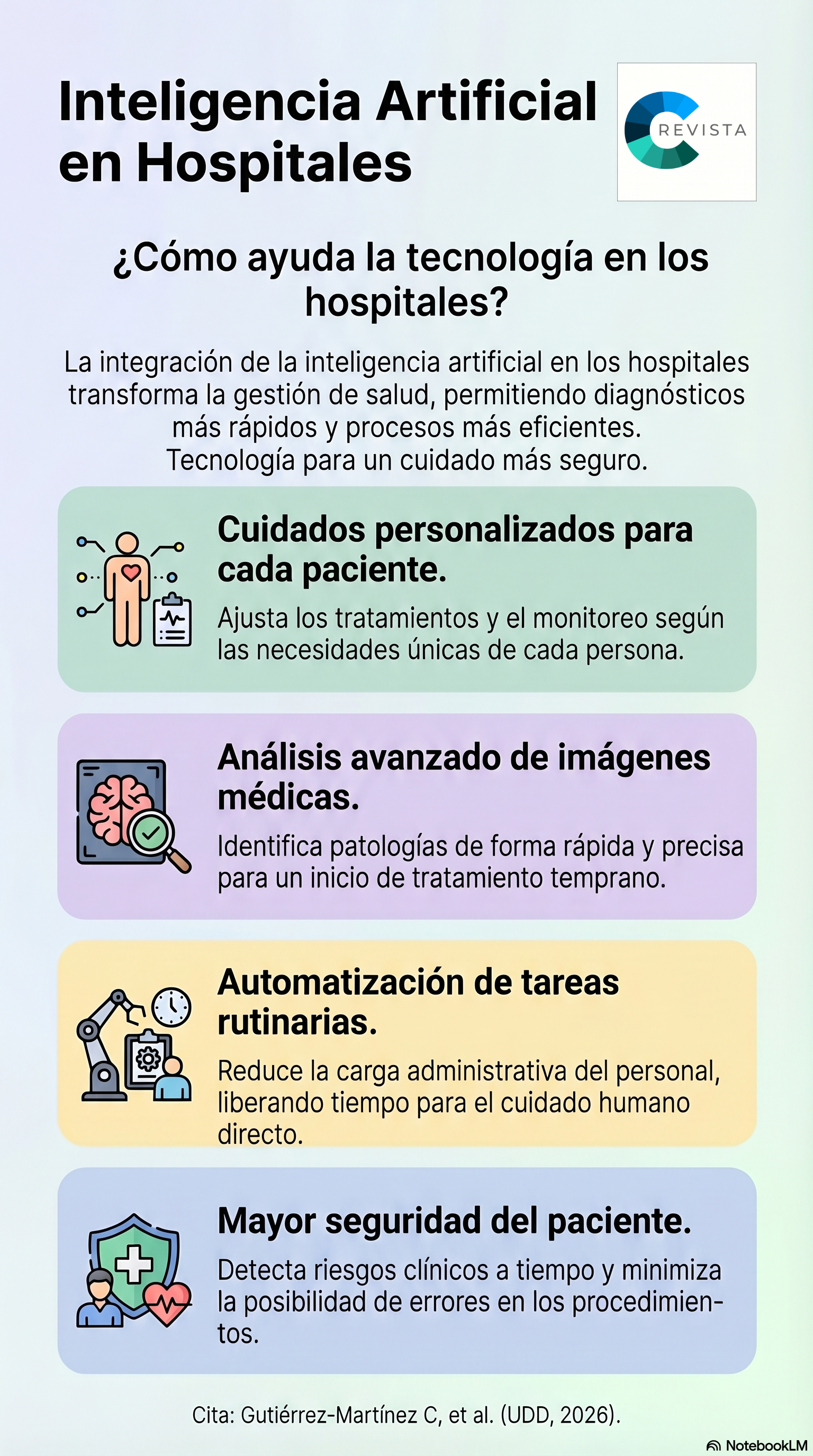
Introducción: El avance de la inteligencia artificial ha impulsado su integración en diversas áreas, destacando el ámbito de salud. Objetivo: Analizar la literatura científica sobre los usos de inteligencia artificial en contexto hospitalario, evaluando usos, beneficios y limitaciones para optimizar procesos de atención y gestión en salud, con el fin de mejorar la calidad y eficiencia del servicio. Metodología: Se realizó una búsqueda de artículos científicos, principalmente revisiones bibliográficas, artículos cualitativos y cuantitativos, utilizando buscadores como PubMed y Web of Science mediante la metodología PRISMA, centrada en entornos hospitalarios. Se seleccionaron 20 artículos. Resultado: Los estudios identifican aplicaciones clave de inteligencia artificial en hospitales, como cuidados personalizados, generación de informes, monitorización, análisis de imágenes y automatización de tareas. Entre los beneficios destacan la detección temprana, seguridad y eficiencia, personalización de tratamientos y reducción de carga laboral. No obstante, enfrentan resistencia del equipo, falta de formación, desafíos éticos, altos costos, dependencia de datos y riesgo de deshumanizar el cuidado. Discusión: La inteligencia artificial ha emergido como una herramienta innovadora en salud, mejorando diagnósticos, tiempos de atención y procesos clínicos. Sin embargo, enfrenta limitaciones en su adopción, lo que exige que los profesionales integren competencias digitales y tecnologías emergentes. Conclusión: La inteligencia artificial aporta mejoras diagnósticas y eficiencia, pero persisten desafíos éticos y escasa evidencia en el contexto chileno. Se sugiere explorar percepciones clínicas y desarrollar marcos éticos.
Referencias
Naciones Unidas y Comisión Económica para América Latina y el Caribe. Índice latinoamericano de inteligencia artificial (ILIA) mantiene a Chile, Brasil y Uruguay como líderes en la región [Internet]. Santiago: CEPAL; 2024 [citado el 26 de junio 2025]. Disponible en: https://www.cepal.org/es/comunicados/indice-latinoamericano-inteligencia-artificial-ilia-mantiene-chile-brasil-uruguay-como
Epoch AI. Investigating the trajectory of AI for the benefit of society [Internet]. Epoch AI: 2025 [citado el 26 de junio 2025]. Disponible en: https://epoch.ai/
Akudjedu TN, Torre S, Khine R, Katsifarakis D, Newman D, Malamateniou C. Knowledge, Perceptions, and expectations of Artificial intelligence in radiography practice: A global radiography workforce survey. J Med Imaging Radiat Sci [Internet]. 2023 [citado el 26 de junio 2025];54(1):104-16. Disponible en: https://doi.org/10.1016/j.jmir.2022.11.016
Vo V, Chen G, Aquino YSJ, Carter SM, Do QN, Woode ME. Multi-stakeholder preferences for the use of artificial intelligence in healthcare: A systematic review and thematic analysis. Soc Sci Med [Internet]. 2023 [citado el 26 de junio 2025];338:116357. Disponible en: https://doi.org/10.1016/j.socscimed.2023.116357
Turing AM. Computing Machinery and Intelligence. Mind [Internet]. 2012 [citado el 26 de junio 2025];49:433-60. Disponible en: https://courses.cs.umbc.edu/471/papers/turing.pdf
Sryker C, Kavlakoglu E. ¿Qué es la Inteligencia Artificial o IA? [Internet]. USA: IBM; 2025 [citado el 4 de julio de 2025]. Disponible en: https://www.ibm.com/mx-es/topics/artificial-intelligence
Amazon Web of Services. ¿Qué es el aprendizaje automático? [Internet]. USA: AWS; 2025. [citado el 4 de julio de 2025]. Disponible en: https://aws.amazon.com/what-is/machine-learning/
Javaid M, Haleem A, Pratap Singh R, Suman R, Rab S. Significance of machine learning in healthcare: Features, pillars and applications. Int J Intell Netw [Internet]. 2022 [citado el 26 de junio 2025];3:58-73. Disponible en: https://doi.org/10.1016/j.ijin.2022.05.002
Miotto R, Wang F, Wang S, Jiang X, Dudley JT. Deep learning for healthcare: review, opportunities and challenges. Brief Bioinform [Internet]. 2018 [citado el 26 de junio 2025];19(6):1236-46. Disponible en: https://doi.org/10.1093/bib/bbx044
Al Kuwaiti A, Nazer K, Al-Reedy A, Al-Shehri S, Al-Muhanna A, Subbarayalu AV, et al. A Review of the Role of Artificial Intelligence in Healthcare. J Pers Med [Internet]. 2023 [citado el 26 de junio 2025];13(6):951. Disponible en: https://doi.org/10.3390/jpm13060951
Gand View Research. Artificial Intelligence In Healthcare Market (2026 - 2033) [Internet]. USA: GVR; 2025 [citado el 4 de julio 2025]. Disponible en: https://www.grandviewresearch.com/industry-analysis/artificial-intelligence-ai-healthcare-market
Medium. 7 limitations of AI in healthcare sector [Internet]. USA: Eastgate Software; 2024 [citado el 4 de julio 2025]. Disponible en: https://medium.com/@eastgate/7-limitations-of-ai-in-healthcare-sector-11f20bbf6923
Van Booven D, Cheng-Bang C, Meenakshy M. Limitations of artificial intelligence in healthcare. En Artificial Intelligence in Urologic Malignancies (Chapter 8). USA: Elsevier; 2025 [citado el 26 de junio 2025]. Disponible en: https://doi.org/10.1016/B978-0-443-15504-8.00008-9
Hadjiat Y, Arendt-Nielsen L. Digital health in pain assessment, diagnosis, and management: Overview and perspectives. Front Pain Res (Lausanne) [Internet]. 2023 [citado el 26 de junio 2025];4:1097379. Disponible en: https://doi.org/10.3389/fpain.2023.1097379
Kwok TC, Henry C, Saffaran S, Meeus M, Bates D, Van Laere D, et al. Application and potential of artificial intelligence in neonatal medicine. Semin Fetal Neonatal Med [Internet]. 2022 [citado el 26 de junio 2025];27(5):101346. Disponible en: https://doi.org/10.1016/j.siny.2022.101346
Ng B, Nayyar S, Chauhan VS. The Role of Artificial Intelligence and Machine Learning in Clinical Cardiac Electrophysiology. Can J Cardiol [Internet]. 2022 [citado el 26 de junio 2025];38(2):246-58. Disponible en: https://doi.org/10.1016/j.cjca.2021.07.016
Barakat-Johnson M, Jones A, Burger M, Leong T, Frotjold A, Randall S, et al. Reshaping wound care: Evaluation of an artificial intelligence app to improve wound assessment and management amid the COVID-19 pandemic. Int Wound J [Internet]. 2024 [citado el 26 de junio 2025];19(6):1561-77. Disponible en: https://doi.org/10.1111/iwj.13755
Racine N, Chow C, Hamwi L, Bucsea O, Cheng C, Du H, et al. Health Care Professionals’ and Parents’ Perspectives on the Use of AI for Pain Monitoring in the Neonatal Intensive Care Unit: Multisite Qualitative Study. JMIR AI [Internet]. 2024 [citado el 26 de junio 2025];3:e51535. Disponible en: https://doi.org/10.2196/51535
Sajjad W, Inam A, Ahmed B, Zahir M, Mujtaba A, Khan Z, et al. Knowledge, attitude, and practices regarding use of artificial intelligence for medical writings among doctors of Khyber Pakhtunkhwa, Pakistan: a cross-sectional study. Ann Med Surg (Lond) [Internet]. 2025 [citado el 26 de junio 2025];87(3):1190-9. Disponible en: https://doi.org/10.1097/ms9.0000000000002953
Khan Rony MK, Akter K, Nesa L, Islam MT, Johra FT, Akter F, et al. Healthcare workers’ knowledge and attitudes regarding artificial intelligence adoption in healthcare: A cross-sectional study. Heliyon [Internet]. 2024 [citado el 26 de junio 2025];10(23):e40775. Disponible en: https://doi.org/10.1016/j.heliyon.2024.e40775
Acosta CG, Ye Y, Wong KLY, Zhao Y, Lawrence J, Towell M, et al. Implementing AI-Driven Bed Sensors: Perspectives from Interdisciplinary Teams in Geriatric Care. Sensors [Internet]. 2024 [citado el 26 de junio 2025];24(21):6803. Disponible en: https://doi.org/10.3390/s24216803
Tangsrivimol JA, Darzidehkalani E, Virk HUH, Wang Z, Egger J, Wang M, et al. Benefits, limits, and risks of ChatGPT in medicine. Front Artif Intell [Internet]. 2025 [citado el 26 de junio 2025];8:1518049. Disponible en: https://doi.org/10.3389/frai.2025.1518049
Mosch LK, Poncette AS, Spies C, Weber-Carstens S, Schieler M, Krampe H, et al. Creation of an Evidence-Based Implementation Framework for Digital Health Technology in the Intensive Care Unit: Qualitative Study. JMIR Form Res [Internet]. 2022 [citado el 26 de junio 2025];6(4):e22866. Disponible en: https://doi.org/10.2196/22866
Jin H, Guo J, Lin Q, Wu S, Hu W, Li X. Comparative study of Claude 3.5-Sonnet and human physicians in generating discharge summaries for patients with renal insufficiency: assessment of efficiency, accuracy, and quality. Front Digit Health [Internet]. 2024 [citado el 26 de junio 2025];6:1456911. Disponible en: https://doi.org/10.3389/fdgth.2024.1456911
Kamel Rahimi A, Pienaar O, Ghadimi M, Canfell OJ, Pole JD, Shrapnel S, et al. Implementing AI in Hospitals to Achieve a Learning Health System: Systematic Review of Current Enablers and Barriers. J Med Internet Res [Internet]. 2024 [citado el 26 de junio 2025];26:e49655. Disponible en: https://doi.org/10.2196/49655
Bhagat SV, Kanyal D. Navigating the Future: The Transformative Impact of Artificial Intelligence on Hospital Management- A Comprehensive Review. Cureus [Internet]. 2024 [citado el 26 de junio 2025];16(2):e54518. Disponible en: https://doi.org/10.7759/cureus.54518
Lindroth H, Nalaie K, Raghu R, Ayala IN, Busch C, Bhattacharyya A, et al. Applied Artificial Intelligence in Healthcare: A Review of Computer Vision Technology Application in Hospital Settings. J Imaging [Internet]. 2024 [citado el 26 de junio 2025];10(4):81. Disponible en: https://doi.org/10.3390/jimaging10040081
Hassanein S, El Arab RA, Abdrbo A, Abu-Mahfouz MS, Gaballah MKF, Seweid MM, et al. Artificial intelligence in nursing: an integrative review of clinical and operational impacts. Front Digit Health [Internet]. 2025 [citado el 26 de junio 2025];7:1552372. Disponible en: https://doi.org/10.3389/fdgth.2025.1552372
Huang G, Wei X, Tang H, Bai F, Lin X, Xue D. A systematic review and meta-analysis of diagnostic performance and physicians’ perceptions of artificial intelligence (AI)-assisted CT diagnostic technology for the classification of pulmonary nodules. J Thorac Dis [Internet]. 2021 [citado el 26 de junio 2025];13(8):4797-811. Disponible en: https://doi.org/10.21037/jtd-21-810
Farah L, Borget I, Martelli N, Vallee A. Suitability of the Current Health Technology Assessment of Innovative Artificial Intelligence-Based Medical Devices: Scoping Literature Review. J Med Internet Res [Internet]. 2024 [citado el 26 de junio 2025];26:e51514. Disponible en: https://doi.org/10.2196/51514
Muzammil MA, Javid S, Afridi AK, Siddineni R, Shahabi M, Haseeb M, et al. Artificial intelligence- enhanced electrocardiography for accurate diagnosis and management of cardiovascular diseases. J Electrocardiol [Internet]. 2024 [citado el 26 de junio 2025];83:30-40. Disponible en: https://doi.org/10.1016/j.jelectrocard.2024.01.006
Alami H, Lehoux P, Auclair Y, de Guise M, Gagnon MP, Shaw J, et al. Artificial Intelligence and Health Technology Assessment: Anticipating a New Level of Complexity. J Med Internet Res [Internet]. 2020 [citado el 26 de junio 2025];22(7):e17707. Disponible en: https://doi.org/10.2196/17707
Hamilton AJ, Strauss AT, Martinez DA, Hinson JS, Levin S, Lin G, et al. Machine learning and artificial intelligence: applications in healthcare epidemiology. Antimicrob Steward Healthc Epidemiol [Internet]. 2021 [citado el 26 de junio 2025];1(1):e28. Disponible en: https://doi.org/10.1017/ash.2021.192
Li M, Zhang H, Xia C, Zhang Y, Ji H, Shi Y, et al. Application Practice of AI Empowering Post-discharge Specialized Disease Management in Postoperative Rehabilitation of the Lung Cancer Patients Undergoing Surgery. Zhongguo Fei Ai Za Zhi [Internet]. 2025 [citado el 26 de junio 2025];28(3):176-82 Disponible en: https://doi.org/10.3779/j.issn.1009-3419.2025.102.11
Yue Y, Zeng X, Lin H, Xu J, Zhang F, Zhou K, et al. A deep learning based smartphone application for early detection of nasopharyngeal carcinoma using endoscopic images. NPJ Digit Med [Internet]. 2024 [citado el 26 de junio 2025];7(1):384. Disponible en: https://doi.org/10.1038/s41746-024-01403-2
Topol EJ. High-performance medicine: the convergence of human and artificial intelligence. Nat Med [Internet]. 2019 [citado el 26 de junio 2025];25(1):44-56. Disponible en: https://doi.org/10.1038/s41591-018-0300-7
He J, Baxter SL, Xu J, Xu J, Zhou X, Zhang K. The practical implementation of artificial intelligence technologies in medicine. Nat Med [Internet]. 2019 [citado el 26 de junio 2025];25(1):30-6. Disponible en: https://doi.org/10.1038/s41591-018-0307-0
Panch T, Mattie H, Atun R. Artificial intelligence and algorithmic bias: implications for health systems. J Glob Health [Internet]. 2019 [citado el 26 de junio 2025];9(2):010318. Disponible en: https://doi.org/10.7189/jogh.09.020318
Publicado
Número
Sección
Licencia
Derechos de autor 2026 Revista Confluencia

Esta obra está bajo una licencia internacional Creative Commons Atribución-NoComercial-SinDerivadas 4.0.