
Development of a Repairable Dermal Layer for Venipuncture Phantoms
Article Sidebar
Article Details
Issue

This work is licensed under a Creative Commons Attribution-NonCommercial-NoDerivatives 4.0 International License.
Downloads
Main Article Content
Abstract
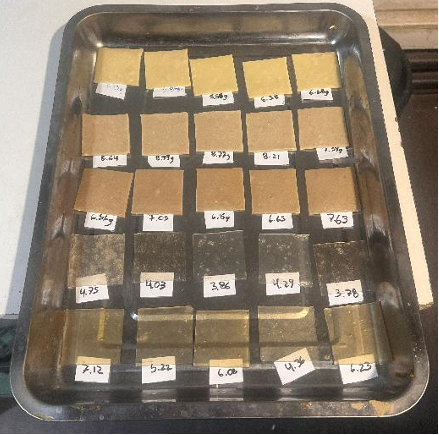
This article presents the results of an interdisciplinary project between the School of Design and the School of Nursing, both at the University of Chile. The project seeks to develop a biodegradable and repairable skin-like material for use in venipuncture phantoms. To this end, a material similar to human skin was developed with a hydrocolloid matrix rich in calcium carbonate. Four formulations were defined with the selected hydrocolloid binder, varying the percentages of each component and organic load. To characterize the materials, their density and moisture content were evaluated, as well as their repairability. Subsequently, the perception of users (nursing students and teachers) was tested. After testing the material, it was used in the phantom developed for the University of Chile School of Nursing, thus verifying the user's perception of the complete phantom. This testing was carried out in a real teaching experience and consisted of venipuncture simulation rotations. The results of the verification showed that the developed dermal layer is even more similar to human skin than the current practice with rubber silicone, in addition to being repairable by dilution with water and biodegradable.
How to Cite
References
Agache, P., & Humbert, P. (Eds.). (2004). Measuring the skin. Springer-Verlag.
Armijo-Rivera, S., Machuca-Contreras, F., Raúl, N., de Oliveira, S. N., Mendoza, I. B., Miyasato, H. S., & Díaz-Guio, D. A. (2021). Characterization of simulation centers and programs in Latin America according to the ASPIRE and SSH quality criteria. Advances in Simulation, 6(1). https://doi.org/10.1186/s41077-021-00188-8
Barros Milla, D. (2021). Desarrollo de un método DIY (hazlo tú mismo) que sistematice la fabricación de materiales que se cocinan a partir de hidrocoloides y residuos orgánicos: Casos de estudio bagazo de té y cáscara de naranja [Tesis de pregrado, Universidad de Chile]. Repositorio Académico de la Universidad de Chile. https://repositorio.uchile.cl/handle/2250/180632
Bogers, L. (2020, marzo 20). Kombucha foil/leather.
Canales, C. (2020). Tonato materia vegetal: Propuesta de refuerzo para compuesto estéticamente símil al cuero natural [Tesis de pregrado, Universidad de Chile]. Repositorio Académico de la Universidad de Chile. https://repositorio.uchile.cl/handle/2250/180620
Cantuarias Brañes, S. (2021). Arquitectura blanda: Geles y biogeles como materiales de diseño arquitectónico [Tesis de pregrado, Universidad de Chile]. Repositorio Académico de la Universidad de Chile. https://repositorio.uchile.cl/handle/2250/186417
Contreras, V. A. Y., Ríos, G. A. S., & Palma, F. A. S. (2021). Importancia de la simulación clínica en el desarrollo de personal y desempeño del estudiante de enfermería. Ciencia y Enfermería, 27. https://doi.org/10.29393/ce27-39isvf30039
Dabrowska, A. K., Rotaru, G. M., Derler, S., Spano, F., Camenzind, M., Annaheim, S., Stämpfli, R., Schmid, M., & Rossi, R. M. (2016). Materials used to simulate physical properties of human skin. Skin Research and Technology, 22(1), 3–14. https://doi.org/10.1111/srt.12235
Dagnino, F. (2025, abril 30). La consolidación de la simulación clínica en las carreras de la salud. La Tercera. https://www.latercera.com/educacion/noticia/la-consolidacion-de-la-simulacion-clinica-en-las-carreras-de-la-salud/
Inostroza Muñoz, M. (2021). Desarrollo de un método DIY (hazlo tú mismo) que sistematice la fabricación de materiales que se cocinan a partir de hidrocoloides y residuos orgánicos: Caso de estudio residuo de concha de mejillón y cáscara de huevo [Tesis de pregrado, Universidad de Chile]. Repositorio Académico de la Universidad de Chile. https://repositorio.uchile.cl/handle/2250/180636
Núñez Herrera, S. (2021). Hacia nuevas materialidades sostenibles: Exploración del residuo cítrico como materia prima para la elaboración de un material compuesto biobasado [Tesis de pregrado, Universidad de Chile]. Repositorio Académico de la Universidad de Chile. https://repositorio.uchile.cl/handle/2250/183763
Read, J., McNaught, K., Hazael, R., & Critchley, R. (2024). Evaluation of soft tissue simulant performance against economic and environmental impact. Environmental Science: Advances, 3(4), 585–602. https://doi.org/10.1039/d3va00403a
Sambuceti Núñez, C., Mejía Díaz, V., & Universidad de Chile, Facultad de Medicina, Escuela de Postgrado. (2016). Simulación clínica con práctica deliberada en el proceso de aprendizaje en estudiantes de enfermería [Tesis de magíster, Universidad de Chile]. https://repositorio.uchile.cl/handle/2250/170944
Smooth-On Inc. (s. f.). Ecoflex™ series technical information [Archivo PDF]. https://www.smooth-on.com/documents/?doc=all#ecoflex-00-10
Smooth-On Inc. (2024). Medical simulation & orthotics/prosthetics. https://www.smooth-on.com/applications/medical-simulation/
Zúñiga, F. (2024, abril 29). Entrevista a Francisco Zúñiga, responsable del Laboratorio de Simulación Clínica, Universidad Austral de Chile (UACh), sede Puerto Montt.