
Systemic Design as an Epistemic Agent: Contributing to Applied Research
Article Sidebar
Article Details

This work is licensed under a Creative Commons Attribution-NonCommercial-NoDerivatives 4.0 International License.
Downloads
Main Article Content
Abstract
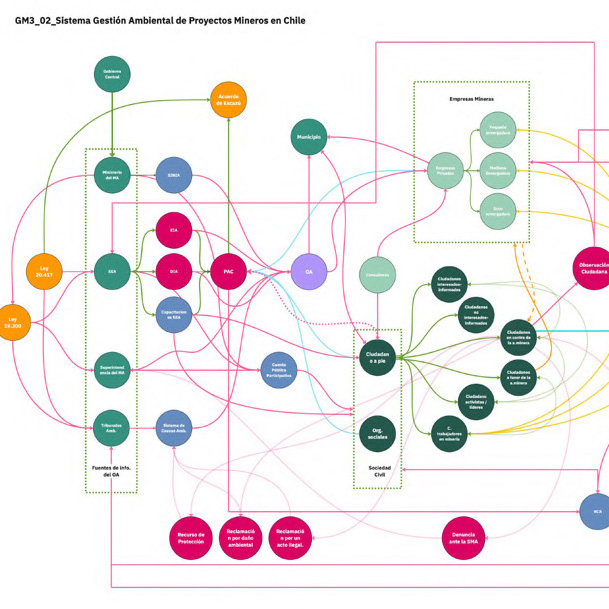
This article examines how systemic design can be integrated into applied scientific research to produce situated, actionable knowledge beyond its traditional role of materializing or communicating findings. We draw on a case study developed through an undergraduate thesis conducted at the Environmental Observatory of Mining Projects (OA)—a project funded by the National Agency for Research and Development through FONDEF IDeA (ID20I10084) and its subsequent technological research phase (IT23I0066). The thesis resulted in a support service designed to facilitate access, understanding, and use of public environmental information. Drawing on a subsequent analysis framed by Research through Design (RtD), this study explores how the integration of systems-oriented design (SOD) and the UC Public Innovation Laboratory's Triple Diamond framework shaped an iterative process of observation, modeling, co-design, prototyping, and validation. Methodologically, we used gigamaps, customer journey maps, service blueprints, and prototypes reframed from a systems perspective to represent actor networks, information flows, institutional dependencies, temporalities, and conditions of access and use. The findings combine a specific service and touchpoints with structural insights into capacity asymmetries, fragmentation of sources, traceability gaps, and temporal mismatches in participation processes. The case suggests that design artifacts can generate process evidence and contribute to formulating and testing situated hypotheses.
How to Cite
References
Bergamini, K., Ángel, P., Rugiero, V., Medina, J. I., & Mollenhauer, K. (2023). Building resilient communities: The Environmental Observatory for Mining Projects and climate change indicators. Sustainability, 15(8), 6947. https://doi.org/10.3390/su15086947
Bergamini, K., Ángel, P., Mollenhauer, K., Medina, J. I., Rugiero, V., & Rodríguez, J. (2025). The Environmental Observatory for Mining Projects: A system for the analysis of public environmental management information. In M. Vicuña & E. Giorgi (Eds.), Intersections: Interdisciplinary research on architecture, design, city and territory (pp. 99–115). Springer. https://doi.org/10.1007/978-3-031-76402-8_7
Blank, S. G. (2007). The four steps to the epiphany: Successful strategies for products that win (3rd ed.). K&S Ranch.
Cárdenas, C., Sosa, R., Moysen, R., & Martínez, V. (2010). Sustaining sustainable design through systemic thinking. International Journal of Engineering Education, 26(2), 287–292.
Chávez López, C. (2021). Diseño y sistemas complejos: Un enfoque multidimensional en el proceso de diseño. RChD: Creación y Pensamiento, 6(10), 1–16. https://doi.org/10.5354/0719-837X.2021.60895
Coughlan, P., Fulton Suri, J., & Canales, K. (2007). Prototypes as (design) tools for behavioral and organizational change: A design-based approach to help organizations change work behaviors. The Journal of Applied Behavioral Science, 43(1), 122–134. https://doi.org/10.1177/0021886306297722
Cross, N. (1999). Design research: A disciplined conversation. Design Issues, 15(2), 5–10. https://doi.org/10.2307/1511837
Culagovski, R., & Del Río Alemparte, C. (2022). Design as a driver for multidisciplinary teams: An applied research case in El Quisco, Chile. diid—Disegno Industriale Industrial Design, (76)12, 156–167. https://doi.org/10.30682/diid7622n
Design Council. (2019). The double diamond: A universally accepted depiction of the design process. https://www.designcouncil.org.uk/resources/the-double-diamond/
Findeli, A., & Coste, A. (2007). De la recherche-creation à la recherche-projet: Un cadre théorique et méthodologique pour la recherche architecturale. Lieux communs, 10, 139–161.
Frayling, C. (1994). Research in art and design. Royal College of Art Research Papers, 1(1). 1–5.
Glanville, R. (2024). The sometimes uncomfortable marriages of design and research. In P. A. Rodgers & J. Yee (Eds.), The Routledge companion to design research (pp. 10–23). Routledge. https://doi.org/10.4324/9781003182443-3
Laboratorio de Innovación Pública UC. (2017). La co-producción del usuario en los servicios públicos. Pontificia Universidad Católica de Chile.
Mollenhauer, K., del Río, C., Rodríguez, J., Silva, K., & Rugiero, V. (2023a). How to build resilient communities? The Chilean Environmental Observatory as an interdisciplinary research case driven by systemic design to empower through information. In proceedings of Relating Systems Thinking and Design, RSD12, Article 173. https://rsdsymposium.org/chilean-environmental-observatory/
Mollenhauer, K., Del Río, C., Rodríguez, J., Bianchi, D., & Riveros, S. (2023b). Logical Design Matrix (LDM): How to operationalize systemic projectual design thinking in complex contexts. Human Systems Engineering and Design (IHSED 2023): Future Trends and Applications, 112, 245–257. https://doi.org/10.54941/ahfe1004135
Mollenhauer, K., del Río, C., Rodríguez, J., Bergamini, K., Rugiero, V., & Medina, J. I. (2024). Multilevel Information Delivery Strategy (MIDS): A strategic design-based model and method for equitable access to environmental information. Human Systems Engineering and Design (IHSED 2024): Future trends and applications, 158, 325–343. https://doi.org/10.54941/ahfe1005556
Mollenhauer, K., Moraga, E., & Bernasconi, R. (2020). Modelo instrumental para proyectos complejos: Poliedro Propuesta de Valor Académico. Bitácora Urbano Territorial, 30(2), 127–140. https://doi.org/10.15446/bitacora.v30n2.81661
Montalván Lume, J., Soria Morales, C., Hopkins Barriga, A., Ascue Yendo, R., & Ajito Lam, E. (2019). Guía de investigación en diseño. Pontificia Universidad Católica del Perú, Vicerrectorado de Investigación. https://cdn02.pucp.education/investigacion/2016/06/12214732/guia-de-investigacion-en-diseno.pdf
Muratovski, G. (2016). Research for designers: A guide to methods and practice. SAGE.
Palmarola, H. (2001). Entrevista a Gui Bonsiepe. ARQ (Santiago), (49), 54–56. https://doi.org/10.4067/S0717-69962001004900029
Ries, E. (2011). The lean startup: How today’s entrepreneurs use continuous innovation to create radically successful businesses. Crown Business.
Rodríguez, J. (2023). Servicio de acompañamiento del Observatorio Ambiental de Proyectos Mineros [Proyecto de título de pregrado no publicado]. Pontificia Universidad Católica de Chile.
Rodríguez, J., Mollenhauer, K., del Río, C., & Bergamini, K. (2025). Designing to support communities in Chilean environmental management: The case of Environmental Observatory (EO) Support Service. Proceedings of Relating Systems Thinking and Design, RSD13, Article 60. https://rsdsymposium.org/chilean-environmental-management/
Salvatierra, R. (2021). Managing strategic participation through design principles: A model for value co-creation in service-based organizations. In W. Karwowski, T. Ahram, D. Etinger, N. Tankovic, & R. Taiar (Eds.), Human systems engineering and design III: Future trends and applications (pp. 69–76). Springer. https://doi.org/10.1007/978-3-030-58282-1_12
Sevaldson, B. (2015). Gigamaps: Their role as bridging artefacts and a new sense sharing model. In Proceedings of the Relating Systems Thinking and Design. https://rsdsymposium.org/gigamaps-as-artefacts/
Sevaldson, B. (2022). Designing complexity: The methodology and practice of systems oriented design. Common Ground Research Networks.
Systemic Design Toolkit. (s. f.). Methodology. https://www.systemicdesigntoolkit.org/methodology