
Designing from Some-Where: Generative AI and Foreclosed Futures in Design
Article Sidebar
Article Details

This work is licensed under a Creative Commons Attribution-NonCommercial-NoDerivatives 4.0 International License.
Downloads
Main Article Content
Abstract
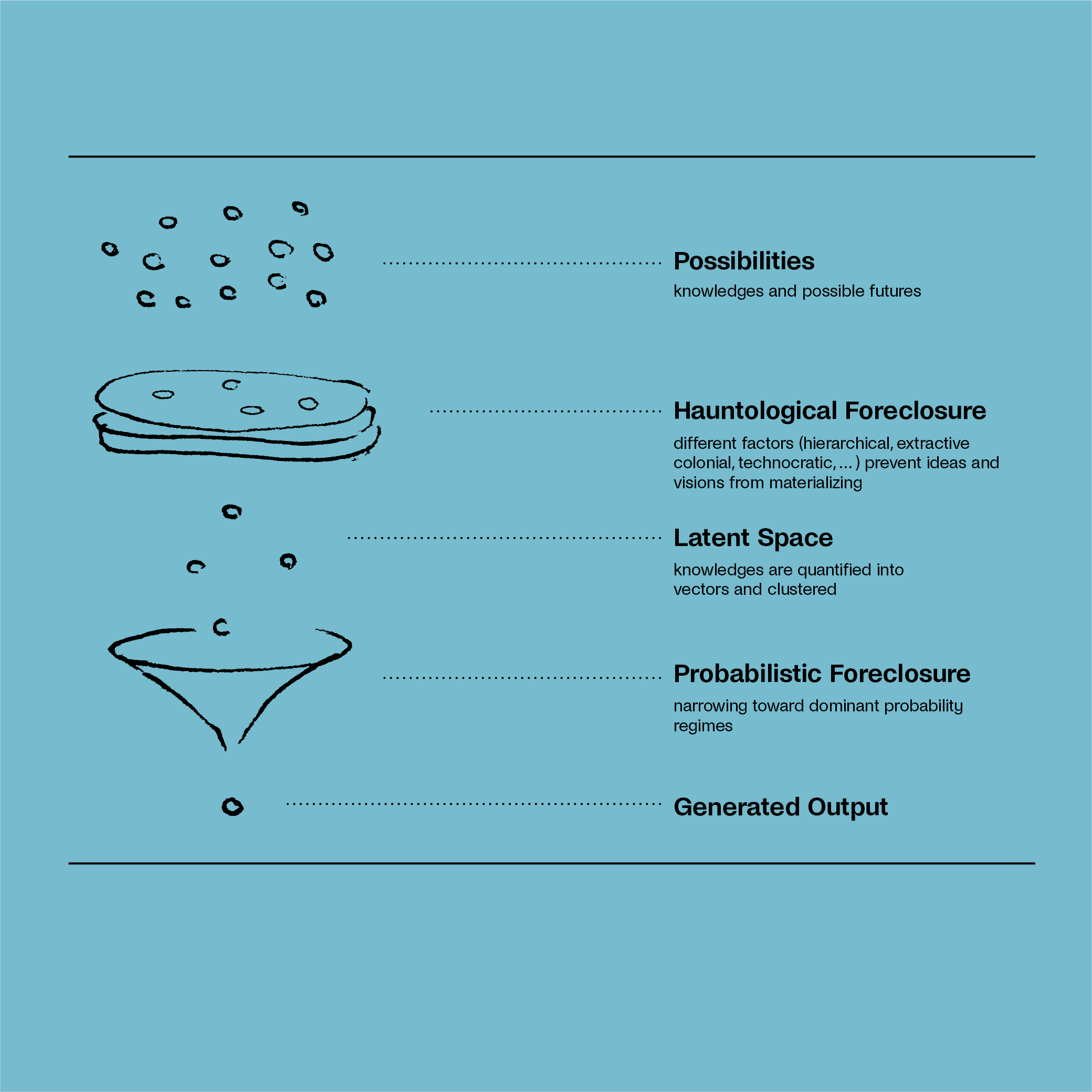
The integration of generative artificial intelligence into design is widely celebrated for accelerating workflows and expanding ideation. This paper argues that this instrumental perspective obscures a critical epistemic shift: generative AI does not just accelerate design processes but structurally truncates already exclusionary practices. By externalizing exploratory, ambiguous, and material form-seeking into probabilistic operations, AI undermines design as a situated knowledge culture. Drawing on theories of epistemic infrastructure, hauntology, and decolonial critique, we analyze how AI systems function as engines of convergence, projecting a dominant view from a specific some-where while presenting it as a neutral standard for everywhere and everyone. Through a double foreclosure, hauntological and probabilistic, these systems favor forms of knowing already present in the dominant digital archive while rendering alternative design futures structurally inaccessible. To counter this homogenization, the paper proposes a conceptual shift. Reimagining AI models not as universalizing infrastructures but as localized carrier bags containing situated epistemologies, we critically examine how such alternatives may reproduce the asymmetries they seek to address. By centering care as a necessary condition for keeping epistemic processes open, designers and educators may protect the processual conditions under which diverse knowledges emerge.
How to Cite
References
Arora, P. (2025). Creative data justice: A decolonial and indigenous framework to assess creativity and artificial intelligence. Information, Communication & Society, 28(13), 2231–2247. https://doi.org/10.1080/1369118X.2024.2420041
Bender, E. M., Gebru, T., McMillan-Major, A., & Shmitchell, S. (2021). On the dangers of stochastic parrots: Can language models be too big? In Proceedings of the 2021 ACM Conference on Fairness, Accountability, and Transparency (pp. 610–623) Association for Computing Machinery. https://doi.org/10.1145/3442188.3445922
Crawford, K. (2021). Atlas of AI: Power, politics, and the planetary costs of artificial intelligence. Yale University Press.
Cross, N. (1982). Designerly ways of knowing. Design Studies, 3(4), 221–227. https://doi.org/10.1016/0142-694X(82)90040-0
Derrida, J. (1994). Specters of Marx: The state of the debt, the work of mourning, and the new international (P. Kamuf, Trans.) Routledge. (Original work published 1993)
Escobar, A. (2018). Designs for the pluriverse: Radical interdependence, autonomy, and the making of worlds. Duke University Press.
Fisher, M. (2014). Ghosts of my life: Writings on depression, hauntology and lost futures. Zero Books.
Fry, T. (2020). Defuturing: A new design philosophy. Bloomsbury Visual Arts. (Original work published 1999)
Haraway, D. (1988). Situated knowledges: The science question in feminism and the privilege of partial perspective. Feminist Studies, 14(3), 575–599. https://doi.org/10.2307/3178066
Hardt, M., Cila, N., & Desmet, P. (2024). Love. The forgotten dimension for just and democratic AI futures. AI futures. In C. Gray, E. C. Chehade, P. Hekkert, L. Forlano, P. Ciuccarelli, & P. Lloyd (Eds.), Proceedings of DRS 2024 (Vol. 2024). Design Research Society. https://doi.org/10.21606/drs.2024.909
Henrich, J., Heine, S. J., & Norenzayan, A. (2010). The weirdest people in the world? Behavioral and Brain Sciences, 33(2–3), 61–83. https://doi.org/10.1017/S0140525X0999152X
Ingold, T. (2013). Making: Anthropology, archaeology, art and architecture. Routledge. https://doi.org/10.4324/9780203559055
Le Guin, U. K. (1988). The carrier bag theory of fiction. In D. Du Pont (Ed.), Women of vision: Essays by women writing science fiction (pp. 1–12). St. Martin’s Press.
Linxen, S., Sturm, C., Brühlmann, F., Cassau, V., Opwis, K., & Reinecke, K. (2021). How WEIRD is CHI? In proceedings of the 2021 CHI Conference on Human Factors in Computing Systems (pp. 1–14). Association for Computing Machinery. https://doi.org/10.1145/3411764.3445488
Manovich, L. (2019). AI aesthetics. Strelka Press.
Mareis, C. (2011). Design als Wissenskultur: Interferenzen zwischen Design- und Wissensdiskursen seit 1960. Transcript.
Meadows, D. H. (2009). Thinking in systems: A primer. Earthscan.
Neuburg, K., Quadflieg, S., & Nestler, S. (2020). Will artificial intelligence make designers obsolete? In M. Engenhart & S. Löwe (Eds.), Proceedings of the First Conference on Designing with Artificial Intelligence (pp. 80–85). Applied AI.
Ofosu-Asare, Y. (2025). Cognitive imperialism in artificial intelligence: Counteracting bias with Indigenous Epistemologies. AI & Society, 40(4), 3045–3061. https://doi.org/10.1007/s00146-024-02065-0
Patil, M., Cila, N., Redström, J., & Giaccardi, E. (2024). In conversation with ghosts: Towards a hauntological approach to decolonial design for/with AI practices. CoDesign, 20(1), 55–76. https://doi.org/10.1080/15710882.2024.2320269
Polanyi, M. (1966). The tacit dimension. University of Chicago Press.
Pragya, A. (2025). Generative AI and epistemic diversity of its inputs and outputs: Call for further scrutiny. AI & Society, 40(4), 2341–2342. https://doi.org/10.1007/s00146-024-02097-6
Puig de la Bellacasa, M. (2017). Matters of care: Speculative ethics in more than human worlds. University of Minnesota Press.
Santos, B. de S. (2015). Epistemologies of the south. Justice against epistemicide. Routledge. https://doi.org/10.4324/9781315634876
Schön, D. A. (1995). Knowing-in-action: The new scholarship requires a new epistemology. Change: The Magazine of Higher Learning, 27(6), 27–34. https://doi.org/10.1080/00091383.1995.10544673
Sinders, C. (2020). Feminist data set. https://carolinesinders.com/wp-content/uploads/2020/05/Feminist-Data-Set-Final-Draft-2020-0526.pdf
Star, S. L., & Ruhleder, K. (1996). Steps toward an ecology of infrastructure: Design and access for large information spaces. Information Systems Research, 7(1), 111–134. https://doi.org/10.1287/isre.7.1.111
Stengers, I. (2010). Cosmopolitics I. (R. Bononno, Trans.). University of Minnesota Press.
Tunstall, E. (Dori). (2023). Decolonizing design: A cultural justice guidebook. The MIT Press. https://doi.org/10.7551/mitpress/14743.001.0001