
Diseño de aislación termoacústica con bioplásticos cítricos en estación intermodal
Article Sidebar
Article Details

This work is licensed under a Creative Commons Attribution-NonCommercial-NoDerivatives 4.0 International License.
Downloads
Main Article Content
Abstract
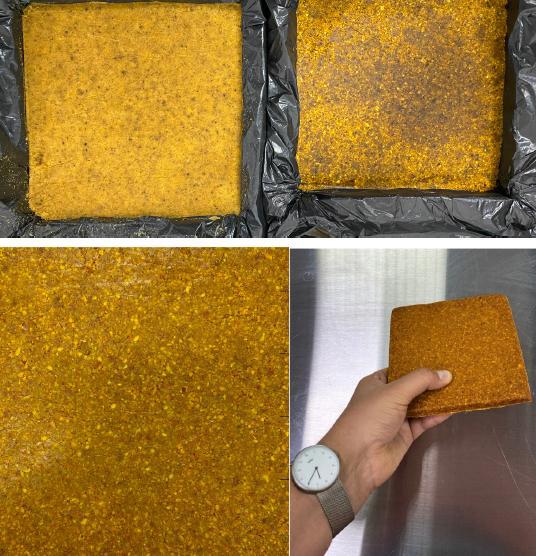
This research addresses environmental pollution related to construction and the lack of effective thermoacoustic insulation in high-traffic urban spaces, using the La Cisterna Intermodal Station in Santiago de Chile as a case study. It develops and validates a bio-based composite material made from orange peels and natural binders as a sustainable alternative to expanded polystyrene (EPS). The methodology focuses on experimental formulation, specimen fabrication, standardized physical, thermal, and acoustic tests, and the design of a modular prototype for platform application. Results demonstrate insulation properties comparable to or exceeding those of EPS, with added benefits in biodegradability, cost-efficiency, and productive viability using agro-industrial waste. These findings support the proposal of this material as a viable solution for small and medium-sized enterprises, fostering environmental linkage and enabling its presentation as a public policy initiative eligible for sustainability and entrepreneurship funding. Originating from a master’s research project, this work contributes technically and environmentally to the construction sector, aligning with Sustainable Development Goals 9, 12, and 13.
How to Cite
References
Ashby, M. F. (2012). Materials and the environment: eco-informed material choice. Elsevier.
Baillie, C., & Vanasupa, L. (Eds.). (2003). Navigating the materials world: a guide to understanding materials behavior. Elsevier.
Bak-Andersen, M. (2018). Cuando la materia conduce a la forma: el diseño guiado por el material y la sostenibilidad. Temes de disseny, 34, 10-31.
Bátori, V., Lundin, M., Åkesson, D., Lennartsson, P. R., Taherzadeh, M. J., & Zamani, A. (2019). The effect of glycerol, sugar, and maleic anhydride on pectin-cellulose thin films prepared from orange waste. Polymers, 11(3), 392.
Buratti, C., Belloni, E., Lascaro, E., Lopez, G. A., & Ricciardi, P. (2016). Sustainable panels with recycled materials for building applications: environmental and acoustic characterization. Energy Procedia, 101, 972-979.
Cámara Chilena de la Construcción. (2022). Memoria anual CChC 2022. https://old.cchc.cl/centro-de-informacion/publicaciones/publicaciones-otras-publicaciones/memoria-anual-cchc-2022
Carpio Toral, M. P. (2014). Diseño estructural de una vivienda aplicando el sistema constructivo STEEL FRAMING (Bachelor's thesis, Universidad del Azuay).
Crul, M. R. M., & Diehl, J. C. (2006). Design for sustainability: a practical approach for developing economies. Unep.
Ellen MacArthur Foundation. (2013). Towards the circular economy: Economic and business rationale for an accelerated transition (Vol. 1). https://www.ellenmacarthurfoundation.org/towards-the-circular-economy-vol-1-an-economic-and-business-rationale-for-an
Ellen MacArthur Foundation. (2015). Towards a circular economy: Business rationale for an accelerated transition. https://www.ellenmacarthurfoundation.org/towards-a-circular-economy-business-rationale-for-an-accelerated-transition
Erkman, S. (2017). Perspectives on industrial ecology. In Perspectives on Industrial Ecology (pp. 338-342). Routledge.
González Donoso, Á. A. (2020). Evaluación de propiedades físicas, mecánicas y térmicas de un biomaterial elaborado con micelio de hongos de pudrición café en sustratos lignocelulósicos [Tesis de pregrado, Universidad de Valparaíso]. Repositorio Bibliotecas UV. https://repositoriobibliotecas.uv.cl/items/051ac0cd-a5d9-490d-9f92-d41f79b47ed3
Jayaraman, P., Pai, A., Rodriguez-Millan, M., Shenoy, S., KN, C., & Hegde, S. (2024). Exploring acoustic properties of banana fiber composites with elastomeric filler through a computational approach. Materials Research Express, 11(1), 015508.
Koizumi, T., Tsujiuchi, N., & Adachi, A. (2002). The development of sound absorbing materials using natural bamboo fibers. WIT Transactions on The Built Environment, 59, 157-166.
Lara Yáñez, M. A. (2024). Diseño de un panel modular desarrollado con bioplásticos de cáscaras de naranjas para la aislación acústica y térmica del área de andenes de la" Estación intermodal La Cisterna" (Tesis de Magíster, Universidad del Desarrollo. Facultad de Diseño). https://hdl.handle.net/11447/9286
Layseca Astudillo, G. (2021). Año Internacional de las Frutas y Verduras 2021: oportunidades para la agricultura chilena. Oficina de Estudios y Políticas Agrarias (ODEPA), Ministerio de Agricultura de Chile. https://bibliotecadigital.odepa.gob.cl/bitstream/handle/20.500.12650/70606/ArtInternacionalFrutasVerduras2021.pdf
Ministerio del Medio Ambiente. (2021). Sexto reporte del estado del medio ambiente. https://sinia.mma.gob.cl/wp-content/uploads/2021/12/REMA-2021.pdf
Ministerio del Medio Ambiente. (2023). Mapa de ruido del Gran Santiago Urbano 2023. https://ruido.mma.gob.cl/mapas-de-ruido/
Naciones Unidas. (2021). Informe de los Objetivos de Desarrollo Sostenible 2021. https://digitallibrary.un.org/record/3932350/files/The-Sustainable-Development-Goals-Report-2021_Spanish.pdf
Organización Mundial de la Salud. (2018). Environmental noise guidelines for the European region. WHO Regional Office for Europe. https://www.who.int/publications/i/item/9789289053563
Organización Mundial de la Salud. (2022). Norma mundial para la escucha segura. https://www.who.int/es/news/item/02-03-2022-who-releases-new-standard-to-tackle-rising-threat-of-hearing-loss
Pathak, P. D., Mandavgane, S. A., & Kulkarni, B. D. (2017). Fruit peel waste: characterization and its potential uses. Current science, 444-454.
Pistofidou, A. (2018). Materiales DIY: diseño guiado por el material y fabricación artesanal en laboratorios de innovación. En Laboratorio de Gobierno de Chile (Ed.), Permitido innovar: Guía para transformar el Estado chileno (pp. 45–52). https://innovadorespublicos.cl/documentation/publication/33/
Thakur, V. K., Thakur, M. K., & Kessler, M. R. (2017). Handbook of composites from renewable materials, biodegradable materials (Vol. 5). John Wiley & Sons.
Wu, G. A., Terol, J., Ibanez, V., López-García, A., Pérez-Román, E., Borredá, C., Domingo, C., Tadeo, F. R., Carbonell-Caballero, J., Alonso, R., Curk, F., Du, D., Ollitrault, P., Roose, M. L., Dopazo, J., Gmitter, F. G., Rokhsar, D. S., & Talon, M. (2018). Genomics of the origin and evolution of Citrus. Nature, 554(7692), 311–316. https://doi.org/10.1038/nature25447