
Making-be of expressions How making activities become material self-expressions supporting pre-schoolers’ well-being
Article Sidebar
Article Details

This work is licensed under a Creative Commons Attribution-NonCommercial-NoDerivatives 4.0 International License.
Downloads
Main Article Content
Abstract
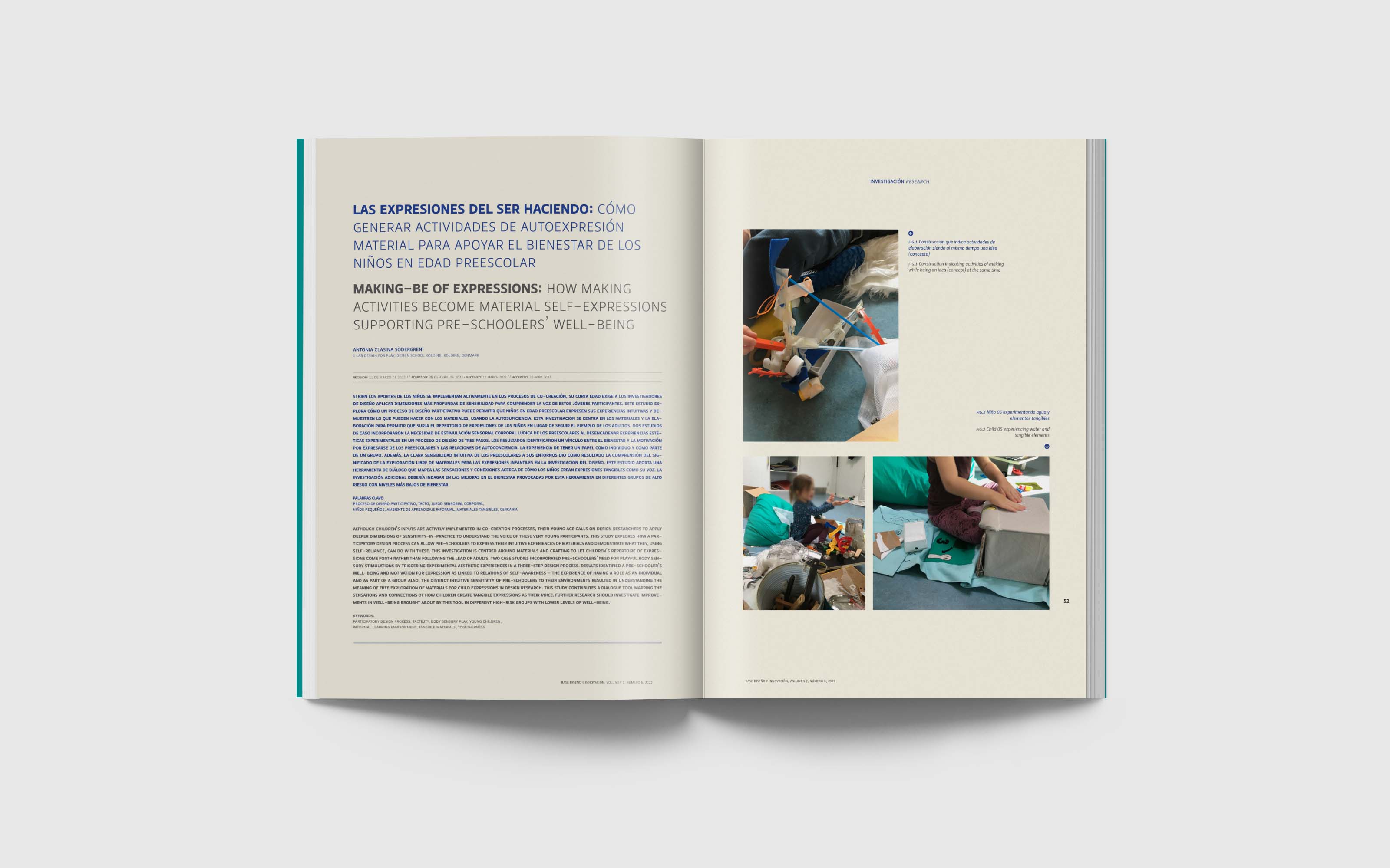
Although children’s inputs are actively implemented in co-creation processes, their young age calls on design researchers to apply deeper dimensions of sensitivity-in-practice to understand the voice of these very young participants. This study explores how a participatory design process can allow pre-schoolers to express their intuitive experiences of materials and demonstrate what they, using self-reliance, can do with these. This investigation is centred around materials and crafting to let children’s repertoire of expressions come forth rather than following the lead of adults. Two case studies incorporated pre-schoolers’ need for playful body sensory stimulations by triggering experimental aesthetic experiences in a three-step design process. Results identified a pre-schooler’s well-being and motivation for expression as linked to relations of self-awareness – the experience of having a role as an individual and as part of a group. Also, the distinct intuitive sensitivity of pre-schoolers to their environments resulted in understanding the meaning of free exploration of materials for child expressions in design research. This study contributes a dialogue tool mapping the sensations and connections of how children create tangible expressions as their ‘voice’. Further research should investigate improvements in well-being brought about by this tool in different high-risk groups with lower levels of well-being.