
Paneles bioaglomerados desde residuos forestales El caso del Eucalyptus globulus Labill
Barra lateral del artículo
Detalles del artículo

Esta obra está bajo una licencia internacional Creative Commons Atribución-NoComercial-SinDerivadas 4.0.
##plugins.themes.bootstrap3.displayStats.downloads##
Contenido principal del artículo
Resumen
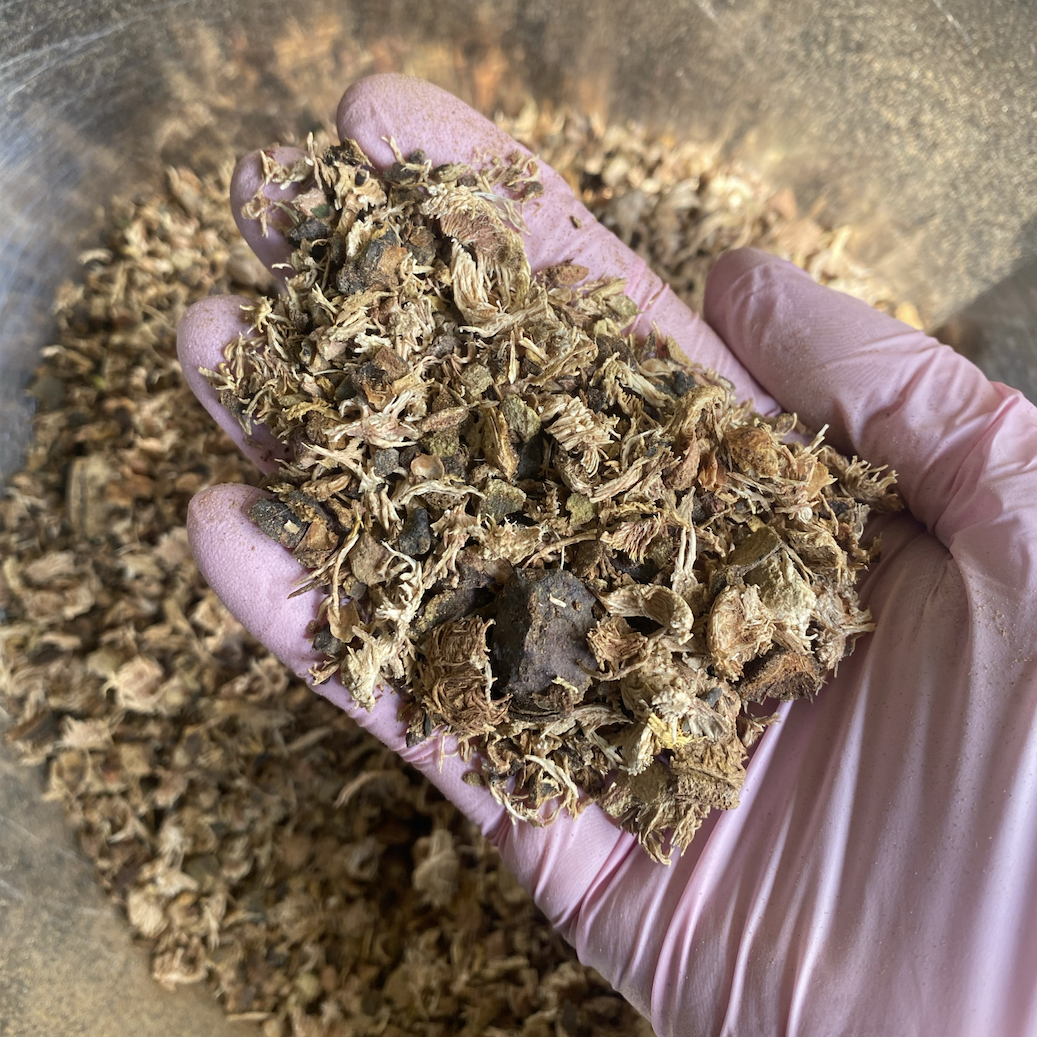
La presente investigación describe el proceso de diseño, desarrollo y validación de paneles bioaglomerados elaborados a partir de cápsulas del Eucalyptus globulus Labill, especie invasora de alta incidencia ambiental en Chile. El estudio se posiciona prioritariamente como una investigación aplicada orientada al desarrollo y validación técnica de un biomaterial, desarrollada en el contexto de un proyecto de tesis guiado durante un año académico desarrollado bajo modalidad de investigación y en estrecha colaboración entre estudiante y docentes. Su propósito fue explorar la viabilidad técnica y sostenible de transformar un residuo forestal en un material funcional, utilizando metodologías de diseño orientadas a la experimentación material y la economía circular. La investigación se estructuró según los enfoques Material Driven Design (MDD) y Biomateriales Basados en el Territorio (BBT), integrando etapas de diagnóstico territorial, caracterización de la materia prima, formulación y fabricación de mezclas, aplicación de pruebas físico-mecánicas y análisis de resultados. Los paneles obtenidos alcanzaron una densidad promedio de 0,82 g/cm³, una absorción de agua del 6,3% y una resistencia a la tracción de 11,4 MPa, evidenciando estabilidad estructural y baja permeabilidad. Los resultados técnico-materiales obtenidos permiten situar el bioaglomerado dentro del rango de materiales lignocelulósicos de baja densidad con potencial de aplicación en diseño de interiores. Más allá de los resultados técnicos, el trabajo reconoce el contexto formativo en el que se desarrolló la investigación, sin constituir esta dimensión un objeto de estudio en sí mismo, demostrando que la práctica académica en pregrado puede contribuir a la generación de conocimiento aplicado en diseño sostenible.
Cómo citar
Referencias
Almulla, M. A. (2020). The Effectiveness of the Project-Based Learning (PBL) Approach as a Way to Engage Students in Learning. Sage Open, 10(3). https://doi.org/10.1177/2158244020938702
Amaya Sánchez, P. A., & Sandoval Jaime, J. J. (2020). Evaluación de la obtención y uso del aceite esencial de eucalipto (eucalyptus globulus) como fungicida.
Bak-Andersen, M., & Falapa, A. (2020). Design for regenerative systems: towards sustainable material cultures. Journal of Sustainable Design, 8(2), 33–49. https://doi.org/10.1016/jsd.2020.02.005
Calderón, T. A. V., Mora, M. M. C., Reyes, S. M. C., Pilay, Y. L. C., Jaramillo, M. L. C., & Wilson, J. M. G. (2024). Economía circular: estrategias para la sostenibilidad en la gestión de recursos. Ciencia y Desarrollo, 27(4), 579-590.
Corporación Nacional Forestal CONAF. (2022). Estrategia Nacional de Cambio Climático y Recursos Vegetacionales (ENCCRV). https://www.conaf.cl
Ellen MacArthur Foundation. (2021). Circular Economy in Cities: Building thriving and resilient communities. https://ellenmacarthurfoundation.org
Food and Agriculture Organization of the United Nations. (2021). Forest Products Annual Market Review 2020–2021. https://www.fao.org
Gustafsson, D. (2019). Analysing the Double diamond design process through research & implementation.
Instituto Forestal de Chile INFOR. (2022). Informe Anual del Sector Forestal Chileno 2022. https://wef.infor.cl
Karana, E., Barati, B., Rognoli, V., & Zeeuw Van Der Laan, A. (2015). Material driven design (MDD): A method to design for material experiences. International Journal of Design, 9(2), 35–54. https://www.ijdesign.org/index.php/IJDesign/article/view/1965?utm
Karana, E., Rognoli, V., & Zeeuw Van Der Laan, A. (2018). Material experiences: fundamentals of materials and design. Elsevier.
Kolb, D. A. (1984). Experiential Learning: Experience as the Source of Learning and Development. Prentice Hall.
Micheloud, A. (s. f.). Cork | pine resin (low heat) Cor02 [Receta de material]. Materiom Commons. Recuperado el 23 de enero de 2026, de https://commons.materiom.org/materials-database/recipe/649c36218e0f06dcab0b7cf2
Ministerio del Medio Ambiente (MMA). (2023). Estrategia Nacional de Economía Circular para Chile. https://hojaderuta.sofofahub.cl
Organización de Naciones Unidas (ONU). (2015). Transformar nuestro mundo: la Agenda 2030 para el Desarrollo Sostenible. Naciones Unidas. https://www.un.org/sustainabledevelopment/es/
Parisi, S., & Rognoli, V. (2020). Tangible narratives: materials and design for sustainability. Design Issues, 36(4), 45–56. https://doi.org/10.1162/desi_a_00609
Pieroni, M., McAloone, T. C., & Pigosso, D. C. (2019). Business model innovation for circular economy and sustainability: A review of approaches. Journal of Cleaner Production, 215, 198–216. https://doi.org/10.1016/j.jclepro.2019.01.036
Seguí, L., Medina, R., & Guerrero, H. (2018). Gestión de residuos y economía circular. EAE Business School. https://www.diarioabierto.es/wp-content/uploads/2018/09/Gestion_residuos_EAE.pdf
Schwarz, T. (s. f.). Sawdust | dextrin Saw05 [Receta de material]. Materiom Commons. Recuperado el 23 de enero de 2026, de https://commons.materiom.org/materials-database/recipe/649c36218e0f06dcab0b7d02
Weiss Münchmeyer, A. J., & Besoain Narvaez, M. J. (2022). Biomateriales basados en el territorio: Metodología para la creación de una paleta biomaterial situada. Base Diseño e Innovación, 7(7), 7¬–25. https://doi.org/10.52611/bdi.num7.2022.797