
Diseñando con las comunidades Un marco para la investigación de pregrado de moda sostenible
Barra lateral del artículo
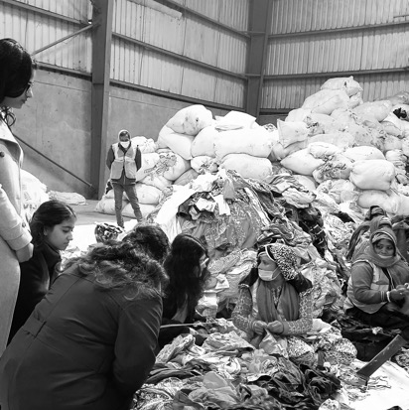
- moda sostenible
- investigación en pregrado
- diseño centrado en la comunidad
- Sistemas Indios de Conocimiento (IKS)
- diseño justo

Esta obra está bajo una licencia internacional Creative Commons Atribución-NoComercial-SinDerivadas 4.0.
Descargas
Contenido principal del artículo
Resumen
La industria de la moda es un ejemplo de producción y consumo insostenibles, que genera graves daños ecológicos y perpetúa prácticas laborales explotadoras. Análisis globales recientes estiman que el sector contribuye con casi 10% de emisiones globales de carbono, desecha una carga de camiones de textiles cada segundo a través de relleno sanitario o incineración, y recicla menos del 1% de las prendas desechadas para convertirlas en ropa nueva. Estas alarmantes cifras subrayan la urgencia de repensar cómo futuros diseñadores e investigadores son educados. Las instituciones de educación superior, en particular escuelas de diseño, están en condiciones de preparar a los graduados para que puedan afrontar los retos entrelazados de la sostenibilidad y la justicia social. Este artículo propone que la investigación de pregrado en moda sostenible, cuando se estructura como práctica centrada en la comunidad, proporciona una poderosa pedagogía para formar investigadores de diseño socialmente responsables. Basándose en los estudios sobre moda sostenible, las tradiciones participativas y de codiseño, los sistemas de conocimiento indios (IKS), y la justicia de diseño, desarrolla un marco de cinco fases: compromiso, exploración, empatía, experimentación y evolución. Cada fase especifica las aportaciones, las competencias, los desempeños y los resultados sociales medibles, y va más allá de los ideales abstractos para llegar a una pedagogía aplicable. Un mini caso y un mapa semestral de 14 semanas muestran la integración en el aula. Al posicionar las comunidades como socios iguales, el marco desafía los modelos extractivos de la investigación en diseño, al tiempo que alinea con las agendas globales de sostenibilidad, incluidos en la OSD y la economía circular.
Detalles del artículo
Citas
Akama, Y., Light, A., & Kamihira, T. (2020). Expanding participation to design with more-than-human concerns. In C. Del Gaudio & L Parra-Agudelo (Eds.) Proceedings of the 16th Participatory Design Conference 2020 – Participation(s) Otherwise Vol. 1 (pp. 1–11). ACM. https://doi.org/10.1145/3385010.3385016
Archer, B. (1995). The nature of research. Co-Design Journal, 1(1), 6–13.
Berger, E. (2020). Empowering artisans through design: a case study on the dynamics of collaborative projects. In S. Boess, M. Cheung, and R. Cain (Eds.), Synergy - DRS International Conference 2020, 11-14 August, Held online. https://doi.org/10.21606/drs.2020.113
Björgvinsson, E., Ehn, P., & Hillgren, P. A. (2012). Design things and design thinking: Contemporary participatory design challenges. Design Issues, 28(3), 101–116. https://doi.org/10.1162/DESI_a_00165
Centre for Sustainable Fashion. (2021). Education for Sustainability Transformation – Progress Report 2021 [Report]. London College of Fashion, University of the Arts London. London. https://d30mzt1bxg5llt.cloudfront.net/public/uploads/sip-reports/00242_CSF_EST_Report_2021-V4-081021.pdf
Clean Clothes Campaign. (2020). Un(der)paid in the pandemic: An estimate of what the garment industry owes its workers. https://cleanclothes.org/file-repository/underpaid-in-the-pandemic.pdf
Costanza-Chock, S. (2020). Design justice: Community-led practices to build the worlds we need. MIT Press.
Cross, N. (2006). Designerly ways of knowing. Springer.
Dastkar. (2018). Crafting sustainable livelihoods: India’s artisans in the 21st century. https://www.dastkar.org/crafting-sustainable-livelihoods/
Dewey, J. (1938). Experience and education. Macmillan.
Ellen MacArthur Foundation. (2017). A new textiles economy: Redesigning fashion’s future. https://www.ellenmacarthurfoundation.org/a-new-textiles-economy
Escobar, A. (2018). Designs for the pluriverse: Radical interdependence, autonomy, and the making of worlds. Duke University Press
Fletcher, K. (2013). Sustainable fashion and textiles: Design journeys (2nd ed.). Routledge. https://doi.org/10.4324/9781315857930
Fletcher, K., & Tham, M. (2019). Earth Logic: Fashion action research plan. The JJ Charitable Trust. https://urn.kb.se/resolve?urn=urn:nbn:se:lnu:diva-92820
Freire, P. (1970). Pedagogy of the oppressed. Herder and Herder.
Fry, T. (2009). Design futuring: Sustainability, ethics and new practice. Berg.
Garcia Martinez, M. (2023). A model of cultural inclusion through the interaction between artisans and product design students. In L. Buck, H. Grierson, & E. Bohemia (Eds.). DS 123: Proceedings of the International Conference on Engineering and Product Design Education (E&PDE 2023). https://doi.org/10.35199/EPDE.2023.96
Gwilt, A. (2015). Fashion design for living. Routledge.
Henninger, C. E., Niinimäki, K., Blazquez, M., & Jones, C. (2022). Sustainable fashion management. Routledge. https://doi.org/10.4324/9781003097846
Irwin, T., Tonkinwise, C., & Kossoff, G. (2020). Transition Design: An educational framework for advancing the study and design of sustainable transitions. Cuadernos del Centro de Estudios de Diseño y Comunicación, (105), 15–32. https://doi.org/10.18682/cdc.vi105.4188
Jégou, F., & Manzini, E. (2008). Collaborative Services: Social Innovation and Design for Sustainability. Edizioni POLI.design.
Jonas, W. (2007). Design Research and its Meaning to the Methodological Development of the Discipline. In R. Michel (Ed.). Design Research Now: Essays and Selected Projects (pp. 187–206). Birkhäuser. https://doi.org/10.1007/978-3-7643-8472-2_11
Kolb, D. A. (1984). Experiential learning: Experience as the source of learning and development. Prentice Hall.
Koskinen, I., Zimmerman, J., Binder, T., Redström, J., & Wensveen, S. (2012). Design research through practice: From the lab, field, and showroom. Elsevier. https://doi.org/10.1016/C2010-0-65896-2
Manzini, E. (2022). Livable proximity: Ideas for the city that cares. EGEA Spa - Bocconi University Press.
Ministry of Education. (2022). Training of Faculty on Indian Knowledge Systems (IKS): A Framework for Higher Education Institutions. Indian Knowledge Systems Division (AICTE–MoE). https://iksindia.org/training-of-faculty-on-iks.pdf
Niinimäki, K. (2018). Sustainable fashion in a circular economy. Aalto ARTS Books. http://urn.fi/URN:ISBN:978-952-60-0090-9
Sanders, E. B. N., & Stappers, P. J. (2008). Co-creation and the new landscapes of design. CoDesign, 4(1), 5–18. https://doi.org/10.1080/15710880701875068
Schön, D. A. (1983). The reflective practitioner: How professionals think in action. Basic Books.
Singh, D. P. (2023). Revisiting Indian Knowledge Systems: Integrating Ancient Wisdom with Contemporary Education under NEP 2020. National Journal of Educational Studies and Research (NJESR), 5(1), 88–92.
United Nations. (2019, August 6). ActNow for zero-waste fashion. https://www.un.org/sustainabledevelopment/blog/2019/08/actnow-for-zero-waste-fashion/
United Nations Educational, Scientific and Cultural Organization (UNESCO). (2019). Education for Sustainable Development beyond 2019. https://unesdoc.unesco.org/ark:/48223/pf0000261625.locale=en
Walker, S. (2014). Designing sustainability: Making radical changes in a material world. Routledge. https://doi.org/10.4324/9781315797328