
Creative and Collaborative Thinking Through Hands-On Manual Paper Recycling in Design Education
Article Sidebar
- experience in materials
- craft processes
- product design
- sustainability

This work is licensed under a Creative Commons Attribution-NonCommercial-NoDerivatives 4.0 International License.
Downloads
Main Article Content
Abstract
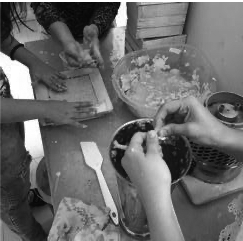
The advancement of environmental challenges and the need for creative solutions make education a fundamental element in the development of innovative minds and creative thinkers capable of analysing and proposing solutions to complex problems. This article explores manual paper recycling as an initiative that combines environmental awareness and artisanal processes as tools for the development of creative skills and adaptive thinking. Through the Action Research methodology and a case study in three collaborative workshops, we seek to understand how practical experimentation with recycled paper fosters innovation and adaptive and flexible thinking in different training contexts. During the activities, participants experiment with pulp manipulation techniques, moulds and pigments, achieving close contact with traditional materials and techniques. The results indicate that manual experimentation generated creative and unique solutions, such as the reinterpretation of colonial icons and the exploration of textures. Preliminary findings show that workshops are spaces with great potential for developing cognitive flexibility and fostering collaboration. These are fundamental aspects for training professionals and citizens who are adaptable to contemporary challenges, demonstrating the pedagogical impact of this initiative.
Article Details
References
Anagnost, A. (2022). Spatial orders, social forms: Art and the city in modern Brazil. Yale University Press.
Associação Brasileira de Empresas de Limpeza Pública e Resíduos Especiais (2024). Panorama dos resíduos sólidos no Brasil em 2024.
Bak-Andersen, M. (2021). Reintroducing materials for sustainable design: Design process and educational practice. Routledge.
Brosens, L., Raes, A., Octavia, J. R., & Emmanouil, M. (2023). How future proof is design education? A systematic review. International Journal of Technology and Design Education, 33(2), 663-683. https://doi.org/10.1007/s10798-022-09743-4
Carvalho, W. O., & Silva, E. B. (2020) Conscientização sobre a Reciclagem do Papel. Pleidade, 14(31), 97–115.
Costa, Y. Á. C., Cohen, L. A. F. P., Ellwanger, E. R. A., Dias, M. R. Á. C., & Canaan, R. P. (2021). O café como elo entre design, espaços museais e turismo no Circuito Liberdade. En Anais do I Colóquio Design e Memória. Sobrado.
Cruchinho, A., & Neves, J. C. (2025). Art, Crafts and Design: Interrelations. In S. Henriques & A. Correia (Eds.), Sustainability in Fashion: Creativity, Education, and Innovation. Springer Nature. https://doi.org/10.1007/978-3-031-80991-0_30
Dumée, L. F. (2022). Circular materials and circular design—Review on challenges towards sustainable manufacturing and recycling. Circular Economy and Sustainability, 2 (1), 9–23. https://doi.org/10.1007/s43615-021-00085-2
Gözene, H. Y., & Metlioglu, H. H. (2025). Zero waste approach in sustainable fashion design: Designer perspective for pre-consumer waste management. Tekstil ve Mühendis, 32(137), 79–93. https://doi.org/10.7216/teksmuh.1471793
Indústria Brasileira de Árvores. (2024). Relatório anual.
Karana, E., Pedgley, O., & Rognoli, V. (2015). On materials experience. Design Issues, 31(3), 16–27. https://doi.org/10.1162/DESI_a_00335
Liu, X., Zhong, F., & Zhang, J. (2025). Design for Recycling. In X. Liu (Ed.), Design for Sustainability (pp. 69–81). Springer Nature Singapore. https://doi.org/10.1007/978-981-96-8657-5_4
Luckman, S., & Andrew, J. (2020). Craftspeople and designer makers in the contemporary creative economy. Springer Nature. https://doi.org/10.1007/978-3-030-44979-7
Manfredi, L. R., Stokoe, M., Kelly, R., & Lee, S. (2021). Teaching sustainable responsibility through informal undergraduate design education. Sustainability, 13(15), 8378. https://doi.org/10.3390/su13158378
McDonough, W., & Braungart, M. (2017). The next industrial revolution. In D. W. Orr & P. H. Hawken (Eds.), Sustainable solutions (pp. 139–150). Routledge.
Mengistu, A. T., Dieste, M., Panizzolo, R., & Biazzo, S. (2024). Sustainable product design factors: A comprehensive analysis. Journal of Cleaner Production, 463, 142260. https://doi.org/10.1016/j.jclepro.2024.142260
Petre, G. E. (2020). Developing students’ leadership skills through cooperative learning: An action research case study. International Forum Journal, 23(2), 143–160.
Sabbaghian, Z., & Mir Moiny, L. S. (2023). The Effectiveness of Educational Workshops: A case study. Quarterly Journal of Research and Planning in Higher Education, 10(3), 1–27.
Saroyan, A., & Amundsen, C. (Eds.). (2023). Rethinking teaching in higher education: From a course design workshop to a faculty development framework. Routledge. https://doi.org/10.4324/9781003446859
Silva, C. F. da, & Castilho, F. F. de A. (2022). A Pesquisa-ação e o design de jogos: uma proposta metodológica para o desenvolvimento de produtos educacionais. Educitec, Revista de Estudos e Pesquisas Sobre Ensino Tecnológico, 8, e180622. https://doi.org/10.31417/educitec.v8.1806
Soares dos Santos, J., Guimarães Santos, J., Teodoro dos Santos, M., & de Farias Meira, E. (2024). The challenges of Handcraft Management and its contributions to Local and Regional Development. Gestão e Regionalidade. https://doi.org/ 10.13037/gr.vol40.e20249380
Sudheshwar, A., Malinverno, N., Hischier, R., Nowack, B., & Som, C. (2023). The need for design-for-recycling of paper-based printed electronics–a prospective comparison with printed circuit boards. Resources, Conservation and Recycling, 189, 106757. https://doi.org/10.1016/j.resconrec.2022.106757
Watkins, M., Casamayor, J. L., Ramirez, M., Moreno, M., Faludi, J., & Pigosso, D. C. (2021). Sustainable product design education: current practice. She Ji: The Journal of Design, Economics, and Innovation, 7(4), 611–637. https://doi.org/10.1016/j.sheji.2021.11.003
Zhang, Y., & Dong, W. (2021). Determining minimum intervention in the preservation of heritage buildings. International Journal of Architectural Heritage, 15(5), 698–712. https://doi.org/10.1080/15583058.2019.1645237
Zi, M. (2021). Sensory Design and Design Thinking for Design Educating. International Journal of Higher Education Pedagogies, 2(3), 1–13. https://doi.org/10.33422/ijhep.v2i3.28
Zuse, S. (2021). Oficinas com argila e pedaços de pote: Aproximações através da experimentação de técnicas tradicionais e de análise cerâmica no rio Madeira. Revista de Arqueologia, 34(2), 203–233. https://doi.org/10.24885/sab.v34i2.863