
Pensamiento creativo y colaborativo a través del reciclaje en la formación en diseño
Barra lateral del artículo
- sostenibilidad
- experiencia en materiales
- procesos artesanales
- diseño de productos

Esta obra está bajo una licencia internacional Creative Commons Atribución-NoComercial-SinDerivadas 4.0.
Descargas
Contenido principal del artículo
Resumen
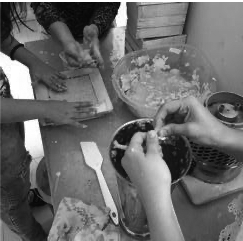
El avance de los desafíos ambientales y la necesidad de soluciones creativas hacen de la educación un elemento fundamental para el desarrollo de mentes innovadoras y pensadores creativos capaces de analizar y proponer soluciones a problemas complejos. Este artículo explora el reciclaje manual de papel como una iniciativa que combina la conciencia ambiental y los procesos artesanales como herramientas para el desarrollo de habilidades creativas y el pensamiento adaptativo. A través de la metodología de investigación-acción y un estudio de caso en tres talleres colaborativos, se busca comprender cómo la experimentación práctica con papel reciclado fomenta la innovación y el pensamiento adaptativo y flexible en diferentes contextos de formación. Durante las actividades, los participantes experimentan técnicas de manipulación de pulpa, moldes y pigmentos, logrando un contacto cercano con materiales y técnicas tradicionales. Los resultados indican que la experimentación manual generó soluciones creativas y únicas, como la reinterpretación de íconos coloniales y la exploración de texturas. Los hallazgos preliminares demuestran que los talleres son espacios de gran potencial para el desarrollo de la flexibilidad cognitiva y el fomento de la colaboración. Estos son aspectos fundamentales para la formación de profesionales y ciudadanos adaptables a los desafíos contemporáneos, demostrando el impacto pedagógico de esta iniciativa.
Detalles del artículo
Citas
Anagnost, A. (2022). Spatial orders, social forms: Art and the city in modern Brazil. Yale University Press.
Associação Brasileira de Empresas de Limpeza Pública e Resíduos Especiais (2024). Panorama dos resíduos sólidos no Brasil em 2024.
Bak-Andersen, M. (2021). Reintroducing materials for sustainable design: Design process and educational practice. Routledge.
Brosens, L., Raes, A., Octavia, J. R., & Emmanouil, M. (2023). How future proof is design education? A systematic review. International Journal of Technology and Design Education, 33(2), 663-683. https://doi.org/10.1007/s10798-022-09743-4
Carvalho, W. O., & Silva, E. B. (2020) Conscientização sobre a Reciclagem do Papel. Pleidade, 14(31), 97–115.
Costa, Y. Á. C., Cohen, L. A. F. P., Ellwanger, E. R. A., Dias, M. R. Á. C., & Canaan, R. P. (2021). O café como elo entre design, espaços museais e turismo no Circuito Liberdade. En Anais do I Colóquio Design e Memória. Sobrado.
Cruchinho, A., & Neves, J. C. (2025). Art, Crafts and Design: Interrelations. In S. Henriques & A. Correia (Eds.), Sustainability in Fashion: Creativity, Education, and Innovation. Springer Nature. https://doi.org/10.1007/978-3-031-80991-0_30
Dumée, L. F. (2022). Circular materials and circular design—Review on challenges towards sustainable manufacturing and recycling. Circular Economy and Sustainability, 2 (1), 9–23. https://doi.org/10.1007/s43615-021-00085-2
Gözene, H. Y., & Metlioglu, H. H. (2025). Zero waste approach in sustainable fashion design: Designer perspective for pre-consumer waste management. Tekstil ve Mühendis, 32(137), 79–93. https://doi.org/10.7216/teksmuh.1471793
Indústria Brasileira de Árvores. (2024). Relatório anual.
Karana, E., Pedgley, O., & Rognoli, V. (2015). On materials experience. Design Issues, 31(3), 16–27. https://doi.org/10.1162/DESI_a_00335
Liu, X., Zhong, F., & Zhang, J. (2025). Design for Recycling. In X. Liu (Ed.), Design for Sustainability (pp. 69–81). Springer Nature Singapore. https://doi.org/10.1007/978-981-96-8657-5_4
Luckman, S., & Andrew, J. (2020). Craftspeople and designer makers in the contemporary creative economy. Springer Nature. https://doi.org/10.1007/978-3-030-44979-7
Manfredi, L. R., Stokoe, M., Kelly, R., & Lee, S. (2021). Teaching sustainable responsibility through informal undergraduate design education. Sustainability, 13(15), 8378. https://doi.org/10.3390/su13158378
McDonough, W., & Braungart, M. (2017). The next industrial revolution. In D. W. Orr & P. H. Hawken (Eds.), Sustainable solutions (pp. 139–150). Routledge.
Mengistu, A. T., Dieste, M., Panizzolo, R., & Biazzo, S. (2024). Sustainable product design factors: A comprehensive analysis. Journal of Cleaner Production, 463, 142260. https://doi.org/10.1016/j.jclepro.2024.142260
Petre, G. E. (2020). Developing students’ leadership skills through cooperative learning: An action research case study. International Forum Journal, 23(2), 143–160.
Sabbaghian, Z., & Mir Moiny, L. S. (2023). The Effectiveness of Educational Workshops: A case study. Quarterly Journal of Research and Planning in Higher Education, 10(3), 1–27.
Saroyan, A., & Amundsen, C. (Eds.). (2023). Rethinking teaching in higher education: From a course design workshop to a faculty development framework. Routledge. https://doi.org/10.4324/9781003446859
Silva, C. F. da, & Castilho, F. F. de A. (2022). A Pesquisa-ação e o design de jogos: uma proposta metodológica para o desenvolvimento de produtos educacionais. Educitec, Revista de Estudos e Pesquisas Sobre Ensino Tecnológico, 8, e180622. https://doi.org/10.31417/educitec.v8.1806
Soares dos Santos, J., Guimarães Santos, J., Teodoro dos Santos, M., & de Farias Meira, E. (2024). The challenges of Handcraft Management and its contributions to Local and Regional Development. Gestão e Regionalidade. https://doi.org/ 10.13037/gr.vol40.e20249380
Sudheshwar, A., Malinverno, N., Hischier, R., Nowack, B., & Som, C. (2023). The need for design-for-recycling of paper-based printed electronics–a prospective comparison with printed circuit boards. Resources, Conservation and Recycling, 189, 106757. https://doi.org/10.1016/j.resconrec.2022.106757
Watkins, M., Casamayor, J. L., Ramirez, M., Moreno, M., Faludi, J., & Pigosso, D. C. (2021). Sustainable product design education: current practice. She Ji: The Journal of Design, Economics, and Innovation, 7(4), 611–637. https://doi.org/10.1016/j.sheji.2021.11.003
Zhang, Y., & Dong, W. (2021). Determining minimum intervention in the preservation of heritage buildings. International Journal of Architectural Heritage, 15(5), 698–712. https://doi.org/10.1080/15583058.2019.1645237
Zi, M. (2021). Sensory Design and Design Thinking for Design Educating. International Journal of Higher Education Pedagogies, 2(3), 1–13. https://doi.org/10.33422/ijhep.v2i3.28
Zuse, S. (2021). Oficinas com argila e pedaços de pote: Aproximações através da experimentação de técnicas tradicionais e de análise cerâmica no rio Madeira. Revista de Arqueologia, 34(2), 203–233. https://doi.org/10.24885/sab.v34i2.863